

With the continuous development of industrialization, flammable, explosive, toxic, and other gases have become widely present in various corners of social life as products, raw materials, or by-products of industrial production. Once these gases leak, they not only pollute the environment, but may also cause poisoning, fires, and even explosions, seriously endangering people's lives and property safety
With the continuous development of industrialization, flammable, explosive, and toxic gases have become widely present in various corners of social life as products, raw materials, or industrial production by-products. Once these gases leak, they not only pollute the environment, but may also endanger people's lives and property safety.
For example, there are a large number of pipelines, valves, and storage equipment in the natural gas industry and chemical plants, which may cause gas leaks due to aging, corrosion, or improper operation. The volatile organic compounds released from biofuels and exhaust emissions can also cause harm to the environment and humans. To prevent major accidents, rapid detection of gas leaks, identification of leak sources, and evaluation of gas distribution and diffusion trends have become urgent issues that need to be addressed.
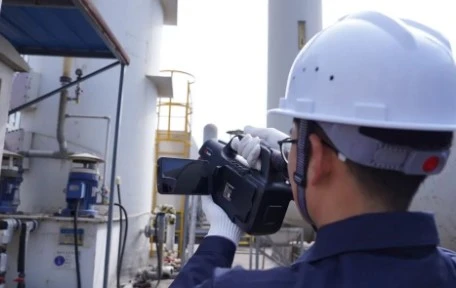
Unveil! Why can an infrared thermal imager "capture" gas leaks?
Traditional gas leak detection methods, such as foam method, funnel method or gas detector, usually have small detection coverage and time-consuming and labor-intensive troubleshooting operations; Detection distance is close, posing a threat to the safety of operators; The detection of gas types is single, requiring multiple detection instruments and not easy to carry; Even in order to detect gas leaks, the production line has to be temporarily shut down, which delays working hours and may even damage normal components.
Gas detection thermal imagers have gradually become the preferred tool in the field of gas leak detection due to their advantages of safety and efficiency.