

Imagine being injured on a remote mountain path but managing to contact emergency services. If an Italian research project succeeds, the first responder could be a small humanoid robot with a jetpack. This project, led by the Artificial and Mechanical Intelligence team at the Italian Institute of Technology, focuses on a bipedal robot named iCub, originally designed for AI research and resembling a child. The goal is to enable iCub to fly using jet propulsion.
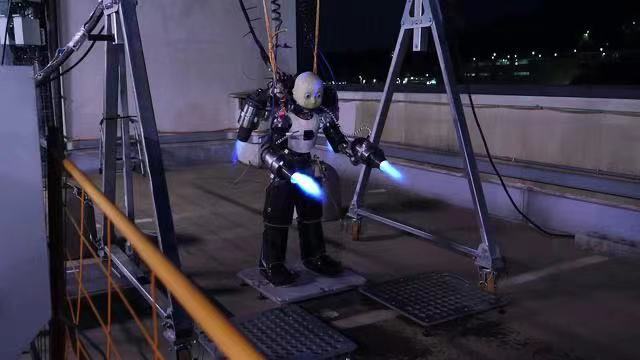
The research team has equipped iCub with a dual jetpack on its back and replaced the robot's original dexterous hands with jet engines, capable of producing a maximum thrust of 1000 N (about 225 pounds-force) and exhaust temperatures reaching 800°C (1,472°F).
Inspired by Tony Stark, this new version of the robot, dubbed iRonCub3, features a newly developed titanium spine to better handle the forces generated during flight. The team also designed new electronics, installed torque sensors in the jetpack, and removed some components to make room for the updated system.
Though the project is still in its early stages, the team has already tested the jet-powered humanoid robot in a wind tunnel to verify flight simulations. While the jets have been fired multiple times, iRonCub3 has yet to achieve actual lift-off. However, the team is confident they will achieve hovering flight in the near future.
Additionally, the research team has developed and analyzed flight control algorithms and validated a trajectory planner in simulations. They are currently using data from an inertial measurement unit and a "perceptive" depth camera mounted on the robot's chest to "estimate the robot's position and orientation in space."
iRonCub3 is equipped with four JetCat P250 Pro-S turbine jet engines, originally designed as propulsion units for remote-controlled aircraft and drones.
Researchers noted, "The complexity of this research axis is starkly different from the classic challenges of humanoid robotics. Thermodynamics play a crucial role here, with turbine exhaust temperatures reaching 800 degrees Celsius and speeds nearing the speed of sound; the aerodynamics of multi-body systems require online evaluation using neural networks and physical information components; controller setup requires a combination of high-bandwidth and low-bandwidth actuators, such as joints and turbines; planners need to generate not only motor dynamics but also turbine trajectories. The experimental validation is as risky as it is critical, leaving little room for improvement."
The ultimate goal is for the humanoid robot to fly to disaster or emergency sites, conduct aerial inspections, or provide critical data to remote personnel. The robot would also be able to land, walk around, navigate obstacles, climb stairs, open doors, and more. This capability could be used not only for first responder scenarios but also for inspecting hazardous buildings or infrastructure.