Pillow packaging machines and edge-seal packaging machines are both continuous heat-seal packaging machines. Their packaging logic, sealing and cutting methods, and suitable products differ. Pillow packaging machines are mainly used for bagging long strip products or small regular products. Edge-seal packaging machines are mainly used for side edge sealing and cutting of large, irregular, or batch regular products.
Differences in product suitability
Pillow packaging machines suit long strip products whose length is clearly greater than width or thickness. Examples include bread, sausages, and ice cream in the food industry, and hardware parts, pipes, and coiled strips in industry. Common single product sizes range from 100 mm to 1000 mm in length and 5 mm to 150 mm in width or thickness. They can also pack multiple products in parallel.
Edge-seal packaging machines suit relatively regular block, box, and large irregular products, such as cartons, gift boxes, large hardware sets, and boards. Single packages can reach 1000 mm or more in length, width, and height. Products do not need to be inserted into a preformed film tube. Flat film covers the outside of the product and is then sealed and cut.
Differences in sealing and cutting process
Pillow packaging machines use roll film to make a bag automatically and then insert the product. Flat roll film is folded into a tube by a former. The product enters the film tube. Longitudinal sealing rollers seal the side of the tube. Cross sealing rollers seal and cut the ends. The finished bag has seals at both ends and forms a pillow shape.
Edge-seal packaging machines use flat film covering plus side edge sealing and cutting. Roll film is cut into flat film sheets of a set size. The sheets cover a single product or a stack of products. The machine heat seals and cuts only 2 to 3 sides of the product. The film does not need to form a tube.
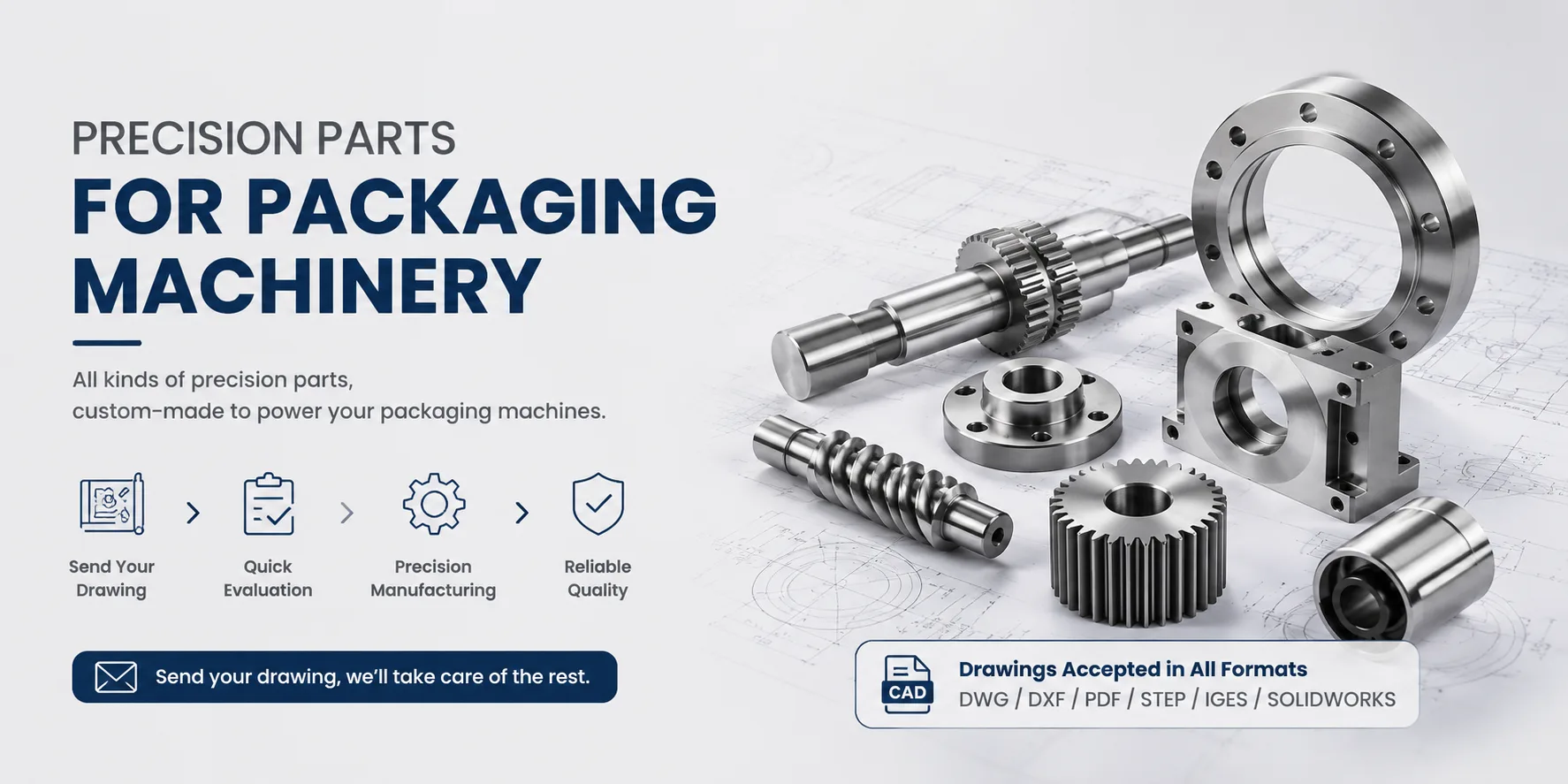
These sealing and cutting processes place precision and wear resistance requirements on parts such as longitudinal sealing rollers, cross sealing rollers, formers, edge sealing knives, cutting knives, traction rollers, film feed rollers, heat sealing knife holders, film guide rollers, drive gears, cams, and timing pulleys. Hansheng Automation can precision-machine these packaging machinery parts in single pieces or small batches according to customer design drawings. We can use stainless steel, aluminum alloy, carbon steel, or engineering plastics, control tolerances to drawing requirements, and provide surface treatments such as anodizing, blackening, nickel plating, or powder coating. This helps the machine keep sealing and cutting position and pressure stable during continuous operation.
Differences in production efficiency and application scenarios
Pillow packaging machines usually run at 30 to 200 pieces/min. They suit continuous production lines and can cover small-batch to large-batch single product packaging. They adapt well to changes in product length. They cannot handle oversized, overweight, or large irregular products.
Edge-seal packaging machines usually run at 10 to 60 pieces/min. They suit single or collective packaging of large products. They can work with automatic carton opening and packing lines to form a complete packaging line. They are more compatible with product thickness and weight, but they cannot handle very small long strip products.
Both machine types have high-temperature sealing parts and drive mechanisms. Keep hands away from the sealing area during operation. Maintenance and troubleshooting require power disconnection. Certified equipment operators should perform the work.
Our custom precision machining capability is not limited to pillow packaging machines and edge-seal packaging machines. In addition to food packaging machinery parts, building materials packaging equipment parts, and chemical packaging equipment parts, we can machine yacht precision parts, RC car precision parts, tobacco packaging machinery parts, filling machinery parts, printing machinery parts, and medical device parts according to drawings. After customers provide drawings, Hansheng Automation can support prototyping and batch production for non-standard parts.