

The upper limit of the quality of gear products depends on the material foundation. Even if you have the best tooth profile design or the most advanced heat treatment solution, if there are defects in the basic gear blank manufacturing process, your gears are destined to not run for a long time.
Gear blanks are the determining factors for the structural integrity, fatigue life, and manufacturing cost of the final components. Choosing the wrong manufacturing process may result in catastrophic gear breakage during on-site operation or increase maintenance costs in the production process.
So how do you choose the manufacturing process? Should you choose casting, forging, or direct machining from bar stock?
Casting
Casting is one of the oldest metal processing techniques mastered by humans, and for specific application scenarios, it remains a highly competitive gear blank manufacturing process. The principle is to inject molten metal into the mold cavity, thereby defining the shape of the blank.
Craftsmanship and Materials
In the field of gears, we usually refer to sand casting or investment casting, and commonly used materials include gray cast iron, ductile iron, or cast steel. After the molten metal cools and solidifies, it forms a shape consistent with the mold.
pros and cons
The biggest advantage of casting is the degree of freedom in geometric shape. If you are designing giant gears for mining ball mills or ship propulsion systems - those with diameters of several meters - casting is often the only feasible solution. It allows you to directly cast complex structures such as spokes and weight reducing holes in the blank, thereby significantly reducing the amount of material removed in the future.
But casting has its inherent weaknesses. The solidification process can easily lead to internal defects such as porosity and shrinkage cavities. In addition, the grain structure of castings is usually random and coarse. This means that compared to forgings, the tensile strength and impact toughness of cast gears are usually lower.
The applicable scenarios are generally large-sized gears, extremely complex geometric structures, low to medium stress applications, and situations that require the excellent shock absorption performance of cast iron.
Attention: Beware of internal hidden defects that will only be exposed after the start of gear cutting processing.
Forging
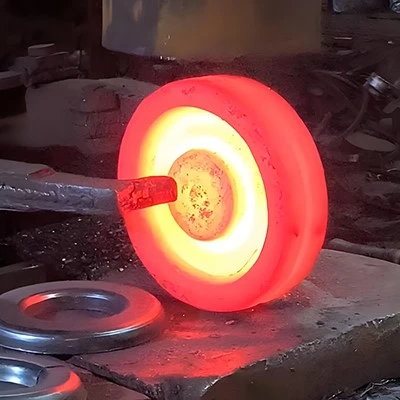
When high load-bearing capacity, impact resistance, and long fatigue life become uncompromising requirements, forging is undoubtedly a superior gear blank manufacturing process. Forging involves heating a metal billet and applying immense pressure using a giant hammer or press to cause it to undergo plastic deformation.
Secret weapon: Grain Flow
Why are forged gears stronger than cast or cut gears? The answer lies in metal grain flow.
Imagine wood. Splitting wood along its texture is much easier than cutting it horizontally. Metals also have similar "textures" or fibrous structures.
In casting: there are no streamline lines, the structure is isotropic but relatively loose.
Cutting: You have cut off the streamline, and the exposed fiber ends may become the starting point of cracks.
In forging, plastic deformation forces metal flow lines to follow the contour of the blank.
This continuous metal streamline forms a "skeleton" inside the part that is consistent with the direction of force on the gear, significantly improving fatigue strength and impact resistance.
Two main forms
Open Die Forging: Used for larger and simpler blanks. It can effectively compact the center of the steel ingot and close the internal pores.
Closed Die Forging: This is the most common gear blank manufacturing process for automotive and industrial gears. Metal is pressed into precision molds to produce "near net formed" blanks with minimal subsequent processing.
Economic considerations
Forging requires expensive molds and heavy equipment. If it is a single prototype, it is not cost-effective. But for batches of over 1000 pieces, forging is often the lowest cost option due to minimal raw material waste and significantly reduced processing time. Suitable for automotive gearboxes, aviation gears, heavy-duty industrial gearboxes, and large-scale production.
Machining from Bar Stock
The third common gear blank manufacturing process is cutting directly from the bar stock. Here, you select a solid round steel (such as 45 # steel, 42CrMo, 20CrMnTi, etc.) and use a CNC lathe or sawing machine to cut it into the size of a gear blank.
The path with the least resistance
This is a 'material reduction' process. You hold a larger piece of material and cut off all the parts that don't look like gears.
The biggest advantage here is agility. You don't need to wait for 8 weeks for the production of casting or forging molds. You can order a steel rod today and get the processed gear blank tomorrow. For prototyping, spare parts replacement, or small batch production (such as 10 to 50 pieces), this is usually the default preferred method.
Compromise in engineering
The disadvantage lies in the structural performance. As mentioned earlier, when you turn gears from bar material, you are disrupting the fiber flow lines of the material. By cutting the longitudinal texture of the rolled bar material, you exposed the grain ends on the gear tooth surface.
Although the quality of modern steel is high enough to make this method acceptable for many general applications, the fatigue life of cut gears is usually lower than that of forged gears under the same material and size.
In addition, the material utilization ratio of this gear blank manufacturing process is the lowest. If you want to process a large gear with a wheel hub, you will turn most of the expensive alloy steel into chips (waste), which will directly increase the material cost per piece.
Its advantage is that there is no need for mold fees (NRE) and the delivery cycle is very fast. Suitable for prototype machines, small batch trials, emergency repair parts, and gears with light to medium loads.
Technology and Business Comparison
To help you understand the differences intuitively, Hansheng compared these three gear blank manufacturing processes together.
|
Feature |
Casting |
Forging |
Machining from Bar |
|
Material Strength |
Low to Medium |
High (Best) |
Medium |
|
Grain Structure |
Random / Porous |
Contoured / Continuous |
Interrupted / Cut |
|
Material Utilization |
High |
High |
Low (High Waste) |
|
Tooling Cost (NRE) |
Medium |
High |
None / Very Low |
|
Lead Time |
Long (Weeks/Months) |
Medium (Weeks) |
Short (Days) |
|
Cost Efficiency |
Best for Very Large sizes |
Best for High Volume |
Best for Low Volume |


Break even point of "cost vs. output"
One of the most critical factors when choosing a gear blank manufacturing process is the 'yield curve'.
If you need 10 gears, bar cutting is a suitable choice. Although the material waste is significant, the total cost is still lower than the cost of opening a set of forging molds (which may reach tens of thousands of yuan).
If you need 5000 gears, forging is the undisputed winner. The initial mold cost is spread over thousands of parts, and the increase in single piece cost is minimal. At the same time, the savings in raw materials and the reduction in machining time (as the blank is nearly net formed) will bring huge profit margins.
Which type of project is suitable for you?
Hansheng provides you with a checklist for the gear blank manufacturing process.
Evaluate load and safety factor
What scenario is this gear used for? If the application involves shock loading, cyclic stress, or safety critical functions, then casting may be given particular consideration.
Analyze geometric shapes
Do gears have large belly plates, complex weight reducing holes, or integrated shells? If the shape is too complex to forge, or turning is too wasteful of materials, casting may be your only geometric solution.
Calculate Total Cost of Ownership (TCO)
Don't just look at the quotation of the raw material, look at the cost of the finished product.
Casting blanks may be cheap to buy, but if there are hard spots (cold zones), it is not friendly for CNC props and will increase processing costs.
Although forging blanks requires high initial investment, their consistent surface smoothness and defect free characteristics can accelerate the speed of gear hobbing and grinding, thereby shortening the cycle time of the entire gear blank manufacturing process.
Consider the impact of heat treatment
Forged materials typically have a denser and more uniform structure, making their reactions to heat treatments such as carburizing and nitriding more predictable. Castings sometimes suffer unpredictable deformation during quenching due to internal inconsistencies.
summary
Based on Hansheng's extensive experience, our suggestion is that there is no absolute "best" gear blank manufacturing process, only the process that best meets your project's output, budget, and performance standards.
Casting: for ultra large scale and complex geometric structures.
Forging: For critical performance, durability, and mass production.
Bar cutting: for speed, flexibility, and small batch orders.
Hansheng is a professional gear manufacturer that provides one-stop precision transmission solutions. If you have any gear related needs, please contact our engineering team immediately or visit our gear manufacturing capabilities page for browsing. We can provide you with comprehensive Design for Manufacturability (DFM) analysis and detailed cost comparisons to help you optimize your gear design. Let's build durable products together.
FAQ
Can all gears be forged?
No. Forging has limitations on shape. If gears have very complex internal cavities, undercuts, or extremely large diameters (such as marine gears exceeding 2-3 meters), forging may be technically impractical or costly. In this case, casting is usually the better choice for gear blank manufacturing process.
What is the specific impact of "metal streamline" on the service life of gears?
The impact is significant. According to industry data we have learned, under the same material and heat treatment conditions, forged gears with continuous metal flow lines typically have a 20% to 30% higher fatigue strength than gears machined by cutting. For transmission gears that withstand high impact loads, this often determines the operating life of the gears.
What is the fastest process if I urgently need a replacement gear?
Machining from Bar Stock. You don't need to wait for mold manufacturing (which usually takes 4-8 weeks). Using inventory of round steel, skilled machining workshops can produce emergency replacement parts for you within 24-48 hours. Although slightly weaker than forgings, it is the fastest solution to solve the shutdown problem.
Which process is most suitable for large bronze worm gears?
For bronze worm gears, centrifugal casting is usually the preferred process.
Although bronze can also be forged, centrifugal casting provides excellent material density and wear resistance, and is highly cost-effective, making it the standard gear blank manufacturing process for large non-ferrous metal gears.
References
ANSI/AGMA 2001-D04 (Reaffirmed 2016)
Fundamental Rating Factors and Calculation Methods for Involute Spur and Helical Gear Teeth.
ISO 6336-5:2016
Calculation of load capacity of spur and helical gears - Part 5: Strength and quality of materials.
AGMA 923-B05
Metallurgical Specifications for Steel Gearing.
Dudley's Handbook of Practical Gear Design and Manufacture (4th Edition)
Stephen P. Radzevich, CRC Press.