

Preface
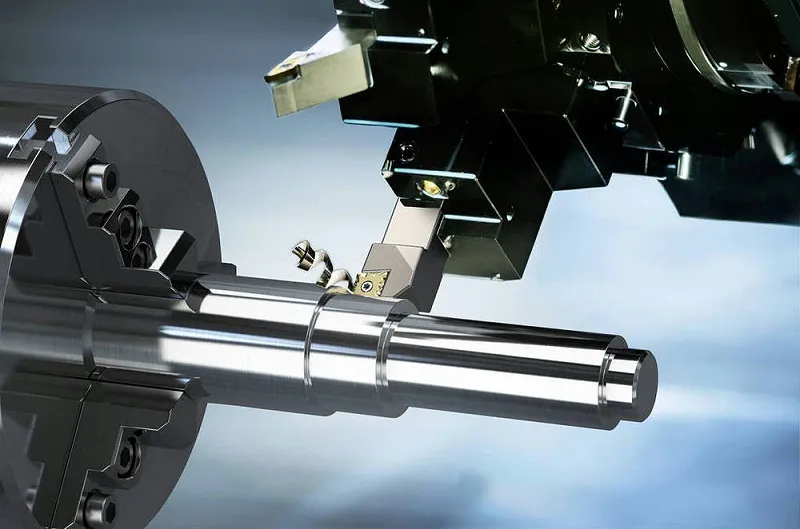
High-precision machining axis machining process analysis is a preparatory process for CNC turning. Whether the process is reasonable has an important impact on the preparation of the program, the processing efficiency of the machine tool and the machining accuracy of the parts. In order to compile a reasonable and practical processing program, programmers should not only understand the working principle, performance characteristics and structure of CNC lathes, master the programming language and programming format, but also master the processing technology of the workpiece and determine a reasonable cutting program. Correct selection of tool and workpiece clamping methods.
The main contents of CNC turning process analysis include: analyzing the processing requirements and rationality of parts according to the drawings; Determine the clamping mode of the workpiece on the CNC lathe; The machining sequence of each face, the feed route of the tool, the number of tools, the fixture, the cutting selection, etc.
Analysis of turning parts diagram
Part diagram analysis is the first task in the development of CNC turning technology. It mainly conducts dimensional method analysis, shape geometric element analysis, accuracy analysis and technical requirement analysis. In addition, the rationality of the part structure and processing requirements should be analyzed, and the process benchmark should be selected.
Selection of fixtures and tools
(1) Turning workpiece clamping positioning
In CNC turning, all or most of the machined surface is processed after a clamping as much as possible, and the number of clamping is reduced as much as possible to improve the processing efficiency and ensure the machining accuracy. For shaft parts, the outer cylindrical surface of the part is usually used as the positioning datum; For sleeve parts, the inner hole is used as the positioning datum. In addition to the universal three-jaw automatic centering chuck, four-jaw chuck, hydraulic, electric and pneumatic fixtures, CNC lathe fixtures also have a variety of special fixtures with good versatility. In practice, it should be reasonably chosen.
(2) Tool selection
In addition to tool life, tool life also has a lot to do with tool diameter. The larger the tool diameter, the greater the amount of removal it can withstand. Therefore, using the largest possible tool diameter is an effective measure to extend tool life and increase productivity as long as the shape of the part allows. The tools commonly used in CNC turning are generally divided into 3 categories, namely sharp turning tools, circular turning tools and forming turning tools.
Selection of cutting amount for turning processing
The amount of stock removal for CNC turning includes the backward feed ap, the spindle speed S (or cutting speed υ) and the feed rate F (or feed f).
The principle of the selection of the amount of stock refuge, the reasonable choice of the amount of stock removal is very important to improve the machining quality of the CNC lathe. When determining the amount of removal of a CNC lathe, it must be selected according to the requirements specified in the machine tool manual and the durability of the tool, or it can be determined by analogy based on actual experience.

Divide the turning process and plan the processing sequence
1) The principle of dividing the turning process
When machining parts on CNC lathes, there are two principles for the common division of processes.
(1) Maintain the principle of accuracy. The process usually requires as much concentration as possible. Roughing and finishing are usually done in a group. In order to reduce the influence of thermal deformation and cutting force deformation on the shape, position accuracy, dimensional accuracy and surface roughness of the workpiece, roughing and finishing should be carried out separately. (2) The principle of improving production efficiency. In order to reduce the number of tool changes, save tool change time, and improve production efficiency, after the parts that need to be processed with the same tool are completed, another tool should be changed to process other parts, and the idle stroke should be minimized.
2) Determine the turning sequence
The following principles are generally followed in the formulation of the processing sequence:
(1) Coarse first and then fine. According to the order of rough turning and semi-finishing turning, the machining accuracy is gradually improved. (2) First far and then far. The parts close to the tool setting point are machined first, and the parts far away from the tool setting point are machined later, so as to shorten the moving distance of the tool and reduce the idle time. In addition, near and far turning helps to maintain the stiffness of the blank or semi-finished product and improve its cutting conditions. (3) Internal and external crossing. For parts with inner and outer surfaces, rough machining of the inner and outer surfaces should be carried out first, and then finishing of the inner and outer surfaces. (4) The base surface goes first. Priority should be given to surfaces that are used as precision datums. The more accurate the positioning datum, the smaller the clamping error.