

1. Applications of pinion Gears in Industrial Settings
Automotive Industry
Conical pinion Gears in Differential Gears
Application Scenario: In the main reducer of rear-wheel-drive vehicles, the helical conical pinion gear meshes with the ring gear to achieve 90° directional transmission. This allows the left and right wheels to rotate at different speeds during turns (e.g., the inner wheel speed decreases by 15-20% when turning).
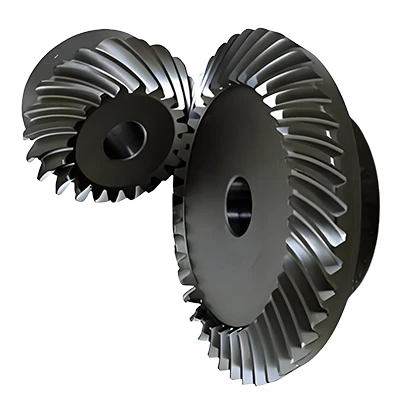
Carbonitrided and quenched steel (e.g., 20CrMnTi) must be selected, with a tooth surface hardness of HRC58-62, to withstand instantaneous torque impacts (e.g., torque can reach 3000 N·m during acceleration).
Electric Power Steering (EPS) Rack and Pinion
With a response time of 50 ms, the pinion in electric power steering meshes with the rack to convert motor rotation into linear motion, therefore saving 30% energy compared to conventional hydraulic systems.
Smart manufacturing
Helical pinion gear sets for robot joints
Using a high-precision helical pinion gearbox with a gear ratio of 1:100 and positioning accuracy of ±0.02 mm, the shoulder joint of a six-axis robotic arm satisfies micro-operation requirements including electronic component welding.
Using titanium alloy tiny gears (density 4.5 g/cm¹), lightweight robots are starting to replace steel gears by 40% while yet preserving tensile strength ≥800 MPa.
Worm gear transmission in CNC machine tools
Application scenario: In the tool changer mechanism of machine tools, the worm gear achieves a reduction ratio of 90:1, ensuring tool positioning error < 0.01mm, suitable for high-speed machining centers (rotational speed 12000rpm+).
Energy and heavy industry
Planetary pinion gears in wind turbine gearboxes
Operational challenges: In the speed-increasing gearbox of a 10MW wind turbine, planetary pinion gears must withstand speeds of 2000 rpm and torque of 1.5×10⁶ N·m. Gear grinding (precision grade ISO 5) and surface coating (TiN) are used to reduce wear.

Straight-tooth pinion gears for mining excavators
Maintenance challenges: The pinion gears in the rotating mechanisms of open-pit mining excavators require weekly inspections of gear surface wear (maximum allowable wear: 0.15 mm/year) due to dusty environments. Oil bath lubrication (viscosity grade ISO VG 460) is used.
Aerospace
Cone-tooth pinion gears for aircraft landing gear retraction systems
Performance specifications: Commercial aircraft landing gear pinion gears must pass 10,000 cycle tests (-55°C to 121°C), with material selection of PH13-8Mo precipitation-hardened stainless steel, yield strength ≥1200 MPa.
Harmonic pinion gears for satellite attitude adjustment mechanisms
Cutting-edge technology: Flexible pinion gears (thin-shell structure) in harmonic drives, with transmission error < 1 arcminute, suitable for remote sensing satellite antenna pointing control (positioning accuracy ≤ 0.05°).
2. Industrial small gear selection 3D model: Load × Environment × Precision
Load parameters (T = torque N・m, P = power kW, n = rotational speed rpm)

Where 9550 is a constant.
Environmental factors
| Environmental Conditions | Recommended Materials | Protective Measures |
|---|---|---|
| High Temperature (>200℃) | Nickel-based Alloy (Inconel 718) | Ceramic Coating (Al₂O₃), Forced Air Cooling |
| Humid Corrosion (Marine conditions) | Titanium Alloy (Ti-6Al-4V) | Anodizing Treatment, Fluororubber Seals |
| Dust/Granule Environment | Surface Quenched Steel (42CrMo) | Labyrinth Sealing, EP Additive in Lubricant |
| Food-grade Clean Requirement | 316L Stainless Steel + Passivation | NSF H1 Certified Food-grade Grease |
Precision grade
ISO Accuracy Grade Selection Reference:
General-purpose transmission (e.g., fans): ISO 8-9 grade (tooth pitch error ≤ 50 μm);
Precision transmission (e.g., robots): ISO 4-5 grade (tooth pitch error ≤ 10 μm), requiring gear grinding process to achieve.
3. Industrial Small Gear Failure Warning and Preventive Maintenance
Identification of Three Typical Failure Modes
Tooth Surface Wear: Mostly caused by inadequate lubrication, tooth surface wear is typified by tooth thickness loss > 0.05 mm. Resolution calls for verifying oil level and changing the filter element (filtering precision ≤ 25 μm).
Tooth root fracture:Usually brought on by impact loads over the fatigue limit-that is, overload during startup-a tooth root fracture results. Installing a torque limiter (set to 1.3 times the rated torque) is part of prevention.
Pitting and spalling: Contact stress more than material allowed value (e.g., steel gears more than 600 MPa.). calls either high-strength steel or gear ratio recalculation.
Maintenance schedule table
| Item | Daily Inspection | Quarterly Maintenance | Annual Overhaul |
|---|---|---|---|
| Tooth Surface Check | Visual inspection for cracks | Penetrant inspection | Tooth profile tester for accuracy deviation |
| Lubrication System | Oil level inspection | Oil change (filtration precision ≤10μm) | Tank cleaning + seal replacement |
| Shaft Alignment | - | Dial indicator: alignment deviation ≤0.05mm/m | Laser alignment adjustment |
Whether you need heavy-duty small gears for wind turbine gearboxes or precision helical gears for robot joints, we offer a full-service process from operational analysis, 3D modeling to performance testing. Contact Hansheng Automation(info@hansmat.com) for a customized solution, or browse our gear product page. All products are ISO 9001 certified and support custom materials (steel/brass/titanium alloy/plastic) and precision grades (ISO 5-8).