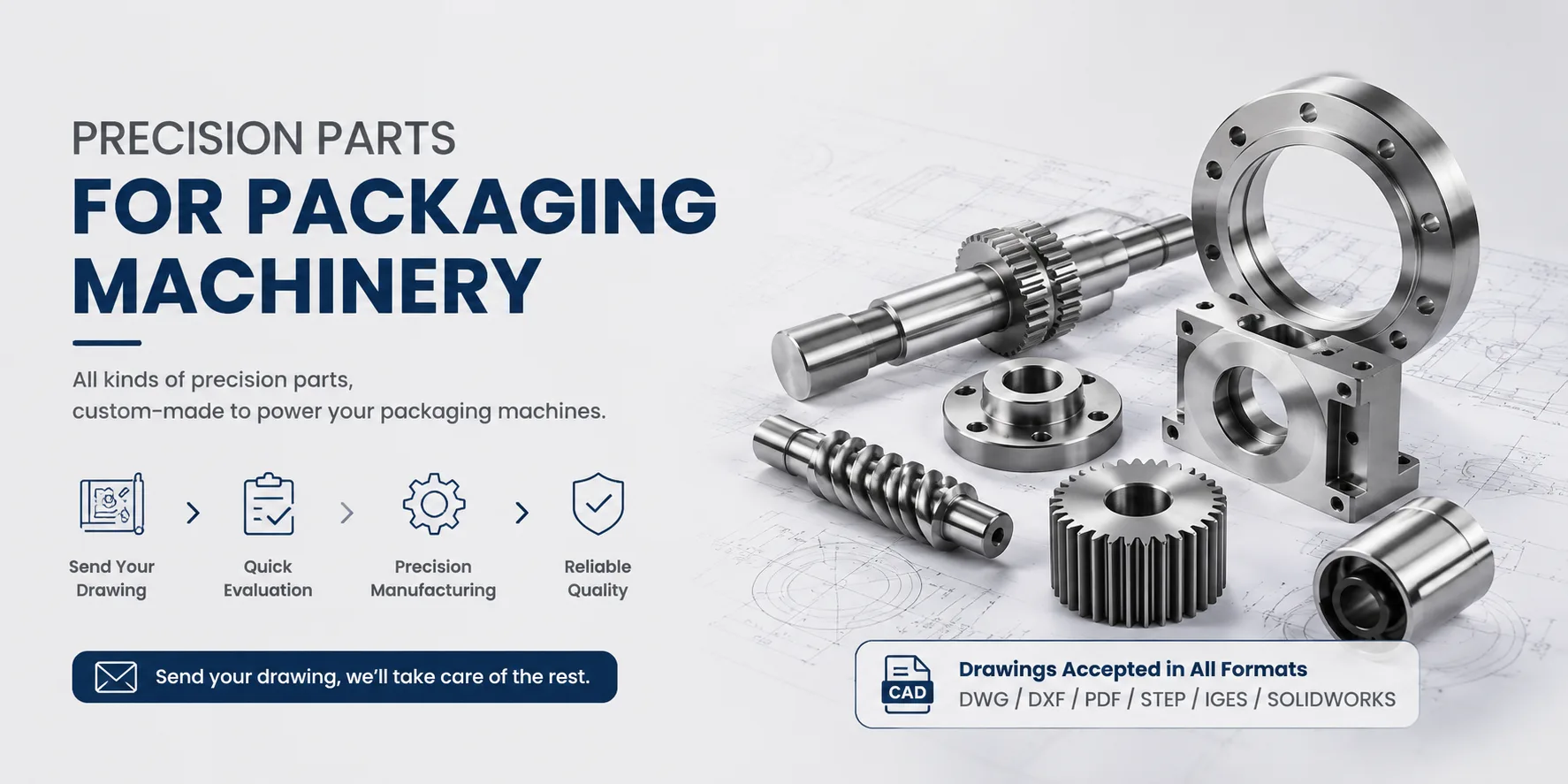
To prevent poor lubrication in automatic palletizer machining, maintenance and operations teams should match the right lubricant to each area, establish a standardized lubrication routine with fixed points, intervals, and quantities, install condition monitoring devices, and check for blocked or leaking lines. When lubrication points require modification or non-standard replacement parts, Hansheng Automation can custom machine precision components such as oil line fittings, sensor mounting bases, and rail mounting plates according to customer drawings, reducing leakage and wear risks caused by fitting deviations.
Match lubricants to each component
Maintenance personnel should use extreme pressure lithium grease (GB/T 7324 L-XBCHA 2) for lifting guide rails and heavy-duty rollers, suitable for -20°C to 120°C, to avoid low-temperature solidification and high-temperature loss. Conveyor sprockets and gears should use high-temperature composite lithium grease (GB/T 7324 L-XBHB 2), with strong shear resistance for heavy-load meshing wear. Rotary bearings and gripper lead screws should use synthetic hydrocarbon grease (ISO VG 220) to maintain transmission accuracy and reduce clearance loss.
Establish a standardized lubrication procedure
Fixed points: maintenance personnel should identify 6 to 8 core lubrication points, including guide rails, sprockets, bearings, and lead screws, and prepare a lubrication identification diagram. Fixed intervals: replenish the lifting guide rails every 150 operating hours, the sprockets every 200 operating hours, and replace the rotary bearing grease every 300 operating hours. Fixed quantities: apply 3 to 5 g of grease per lubrication point, and control the amount strictly to avoid excess grease interfering with palletizing accuracy. Work requirements: operators should shut down and disconnect power, attach warning signs, and wait until the equipment is fully stopped before working. Live work is strictly prohibited.
Install lubrication condition monitoring devices
An online oil level sensor can monitor lubrication line pressure and oil level, and trigger an audible and visual alarm when below the threshold. A vibration monitoring module determines insufficient lubrication and issues a warning when bearing vibration amplitude exceeds 0.5 mm/s. A line leakage detector can detect grease leakage in real time to prevent lubrication failure and resulting wear.
Regularly inspect and eliminate hidden risks
Maintenance personnel should clean the lubrication line filter every week and check whether lines are bent or blocked. Clear or replace faulty lines. Every month, inspect 1 to 2 lubrication points. If the grease has dried or changed color, replace all grease in the corresponding area. Every quarter, check the meshing clearance of gears and sprockets. If it exceeds 0.2 mm, adjust it and replenish grease at the same time.
Beyond the lubrication and transmission parts of automatic palletizers, our custom precision parts machining capability also covers yacht precision parts, RC car precision parts, tobacco packaging machinery parts, and filling machinery parts. Hansheng Automation can also machine non-standard parts for printing machinery, food machinery, and medical devices according to drawings, supporting customers with drawing-based customization and small-batch delivery.