To improve laser marking speed without sacrificing marking depth, measures can be grouped into four categories: optimizing laser parameters, adjusting equipment configuration, optimizing marking process paths, and matching appropriate processing conditions.
1. Optimizing Core Laser Parameters
Adjusting laser pulse parameters
Within the limit of material thermal damage, single-pulse energy and pulse repetition frequency can be increased. Slightly compressing pulse width while raising peak power helps maintain stable single-pulse etching energy. A higher repetition frequency supports faster scanning without reducing the number of pulses per unit area, which would otherwise weaken marking depth. Duty cycle should also be controlled to avoid excessive heat accumulation and thermal deformation, while keeping laser output power stable for consistent depth.
Adjusting scanning system parameters
Using a high-speed galvanometer with a scanning frequency of at least 10 kHz reduces reversal delay and shortens idle travel time. Selecting a suitable focal length for the field lens is equally important. A shorter focal length increases spot energy density, producing deeper etching at the same laser power and allowing higher scanning speed while maintaining the required depth.
2. Adjusting Equipment Configuration
Upgrading core components
A laser source with high beam quality, such as a single-mode fiber laser, delivers a smaller spot diameter and more concentrated energy. This can achieve deeper marking at the same power level, making it possible to increase scanning speed without losing depth. An efficient water cooling system is also necessary to keep the laser and galvanometer temperatures stable, preventing thermal drift, spot shift, and energy attenuation during long production runs.
Adding auxiliary processing devices
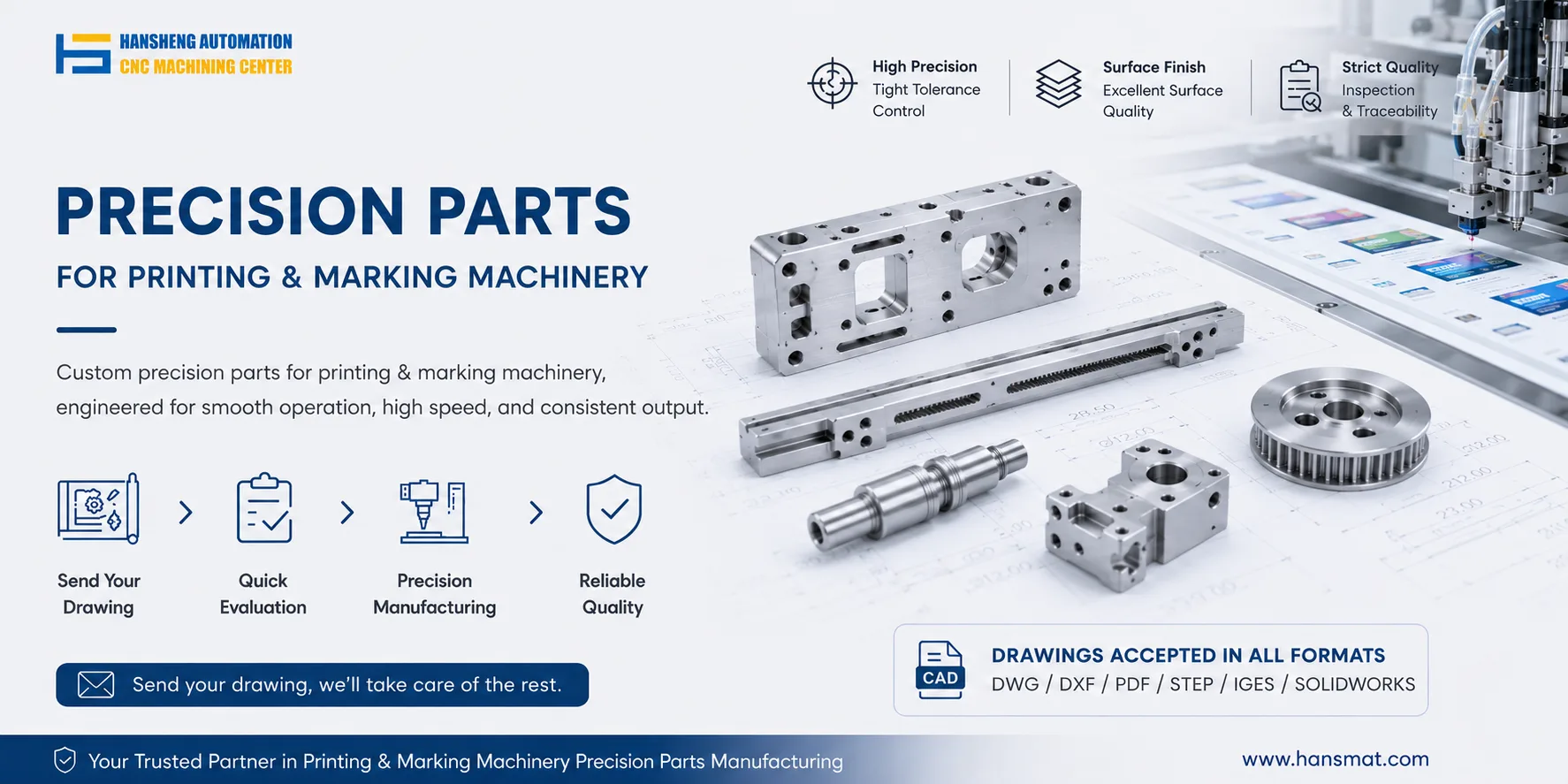
An air or nitrogen blowing system removes slag, hot vapor, and spatter from the marking area, reducing laser energy loss and heat buildup. An online monitoring system can track marking depth and laser output power in real time, allowing prompt parameter compensation and more confident speed increases. For custom mounting brackets, nozzle adapters, or fixture plates required in these upgrades, Hansheng Automation provides precision machining according to specific equipment models.
3. Optimizing Marking Process Paths
Improving fill strategy
Continuous spiral filling reduces the number of galvanometer direction changes compared with conventional line-by-line filling, cutting idle travel and increasing effective marking time. Simplifying the marking path and merging adjacent graphics also reduces non-marking movement.
Using layered marking
For deep marking requirements, the total etching depth can be divided into 2 to 5 layers, with each layer controlled between 0.01 mm and 0.05 mm depending on material and depth needs. Each layer can then be processed at a higher scanning speed, avoiding thermal overload and uneven depth caused by a single deep pass, and improving overall throughput.
4. Matching Appropriate Processing Conditions
Pretreating materials
Material-specific pretreatment helps improve laser absorption and depth consistency. For metals, light sandblasting can remove surface oxide layers. For plastics, low-temperature baking removes surface moisture and prevents bubbles during marking. These steps allow higher scanning speeds without compromising depth.
Stabilizing the processing environment
Workshop temperature should be maintained between 18 °C and 25 °C, with relative humidity between 40% and 60%. High temperature and humidity can reduce laser energy output and degrade galvanometer performance, leading to unstable depth. A stable environment supports consistent marking and sustained high scanning speed.