Producing a pad printer base mold involves design, material selection, machining, surface treatment, and quality verification.
Design
The base mold is designed according to product shape and printing pattern. Dimensional accuracy and edge definition are important for proper fit with curved surfaces. Allowance must be made for ink expansion during transfer.
Material selection
Steel is preferred for high-volume production. Aluminum alloy is used for lightweight, lower-wear applications. Epoxy resin molds are suitable for small-batch trials and should have a heat deflection temperature at least 15 to 20°C above the ink curing temperature.
Machining
CNC machining achieves micro-scale engraving with positioning accuracy around 0.01 mm. Typical spindle speeds are 800 to 1200 rpm for steel and 1800 to 2500 rpm for aluminum. For casting, melt temperatures are approximately 680 to 720°C for aluminum and 1450 to 1520°C for steel. When 3D printing is used, a Z-axis resolution of no less than 50 microns is recommended for photopolymer resins.
Surface treatment
Electroless nickel plating with a thickness of 8 to 15 μm or Teflon coating at 30 to 50 μm improves release and wear resistance. Mirror polishing to below Ra 0.2 μm can increase ink transfer efficiency by 20 to 35%.
Pattern etching
Chemical etching uses ferric chloride solution at 38 to 42% concentration, with an etching rate of 0.02 to 0.05 mm/min. Laser etching parameters depend on the material. For steel molds, 20 to 30 W power and 1000 to 1500 mm/s scanning speed are typical, with a depth-to-width ratio between 1:3 and 1:5.
Quality inspection
Flatness is checked with a coordinate measuring machine to within ±0.005 mm. Surface roughness is measured with a profilometer. Pattern edge sharpness is visually inspected at 20 to 50× magnification.
Installation and trial
The base mold platform must be leveled to within 0.01 mm. Initial doctor blade pressure is set to 0.2 to 0.3 MPa. A trial run of 100 continuous prints verifies pattern consistency, with fine adjustments to curing temperature and demolding angle.
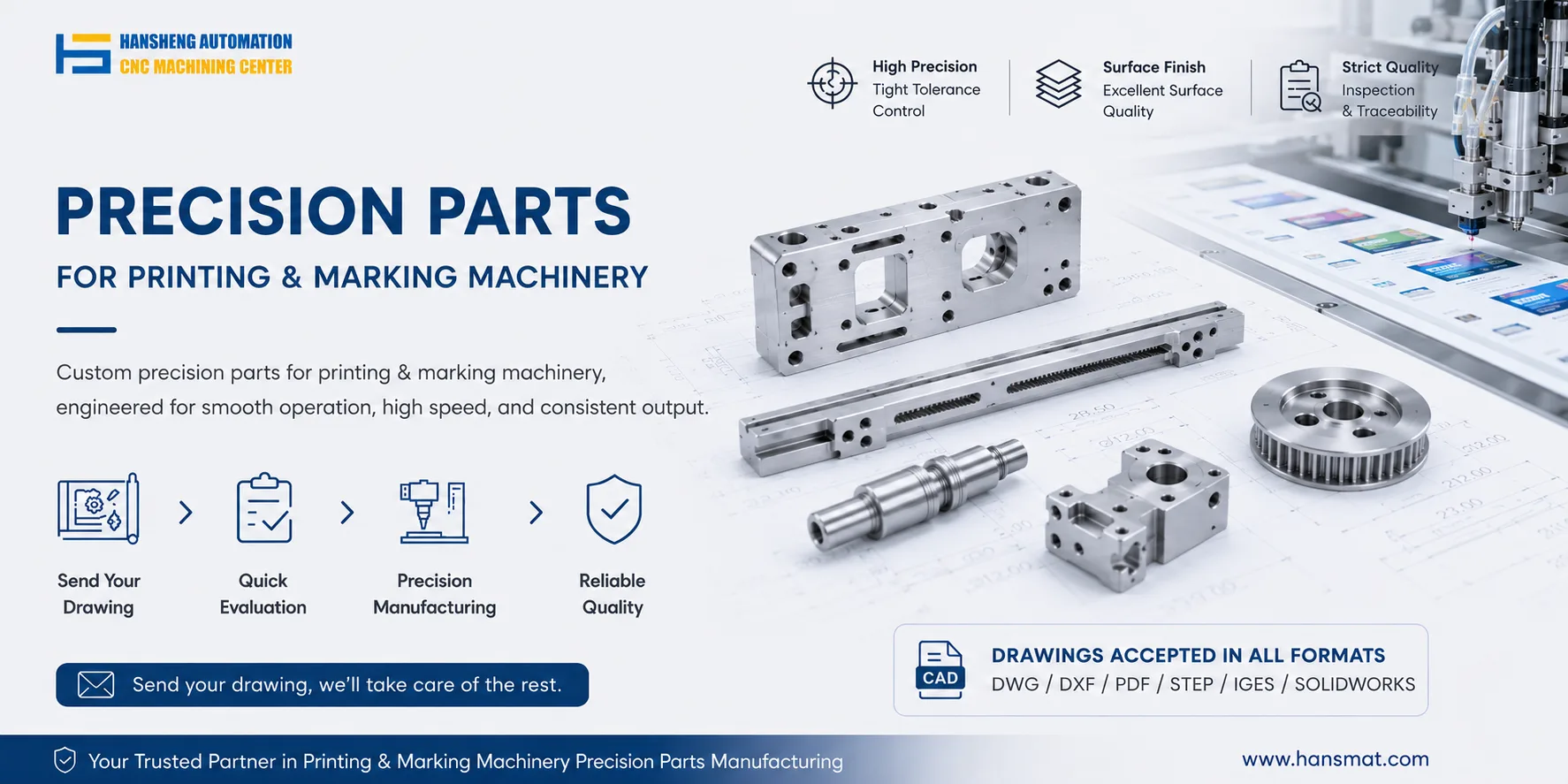
For custom base molds, Hansheng Automation can manufacture according to customer drawings or sample parts, with tight control of flatness, surface finish, and pattern accuracy.