Automatic packaging machines usually run in a fixed timed cycle. The main stages include feeding preparation, bag forming or bag pickup, weighing and filling, sealing and shaping, finished product output, and fault protection. Vertical form fill seal machines, premade bag machines, and other models differ in the bag forming stage, but the overall process is similar.
Feeding and preparation
(1) Material and packaging material supply
Bulk granules, powders, and liquids are fed into dedicated weighing hoppers by vibration feeders, screw conveyors, piston pumps, and other conveying equipment.
Premade bag packaging machines use suction cup manipulators to pick empty bags from a bag magazine, open the bag mouth, and position the bag at the station. Vertical form fill seal machines use an unwinding unit to feed plastic composite packaging roll film.
(2) Process parameter initialization
Operators enter process parameters such as packaging weight, sealing temperature, bag length, and running speed in advance. The system automatically calibrates photoelectric sensors and runs a pre-start self-check on drive motors.
Bag forming and filling
(1) Packaging carrier forming
Vertical form fill seal machines: after the composite film is pulled by guide rollers, the longitudinal sealing heater seals the side edge, and the cross sealing heater seals the bag bottom to form an open bag.
Premade bag packaging machines: they use pre-made empty bags directly and place the bag body at the filling station with a manipulator.
(2) Accurate weighing and filling
Granular materials use cup or screw weighing devices to fill the set weight into the bag cavity.
Liquid and paste materials use piston pumps or flow meter weighing mechanisms for measured injection.
Powder filling is equipped with a dust hood to reduce dust pollution to the machine and workshop.
Sealing and finished product handling
After filling, the heat sealing device adjusts sealing temperature and pressure according to the packaging material type. Common temperature is 120°C to 180°C. It completes heat pressure sealing of the bag mouth.
Most models integrate an inkjet coding device to print production date, product batch, and other traceability information on the package surface.
After sealing, the cutting device separates the finished bag from the roll film web or empty bag magazine according to the preset bag length. Premade bag models unload finished bags directly with a manipulator.
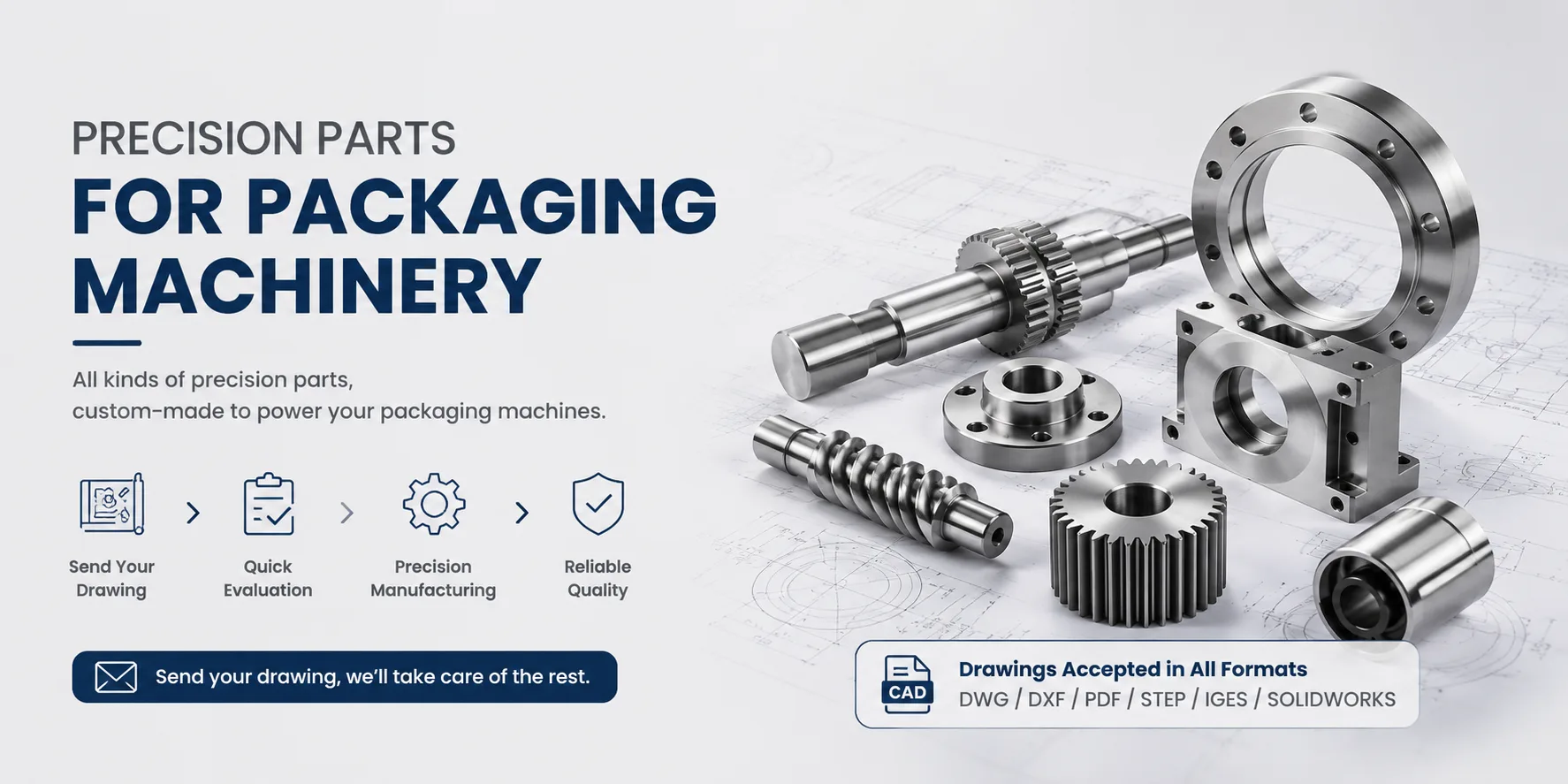
These steps place precision and wear resistance requirements on parts such as suction cup manipulators, bag clamping mechanisms, formers, longitudinal sealing heaters, cross sealing heaters, cutting knives, measuring cups, screws, piston pump connectors, guide rollers, conveyor belt wheels, cams, and timing pulleys. Hansheng Automation can precision-machine these packaging machinery parts in single pieces or small batches according to customer design drawings. We can use stainless steel, aluminum alloy, carbon steel, or engineering plastics, control tolerances to drawing requirements, and provide surface treatments such as anodizing, blackening, nickel plating, or powder coating.
Output and fault protection
Qualified finished products are sent by belt conveyor to a temporary storage area or automatic palletizing station.
The system monitors abnormal conditions in real time, such as low material, failed sealing, bag jamming, and weighing out of tolerance. It triggers an audible and visual alarm and locks the station. After manual inspection and repair, the machine resumes automatic operation.
Our custom precision machining capability is not limited to automatic packaging machines. In addition to food packaging machinery parts, filling machinery parts, and tobacco packaging machinery parts, we can machine yacht precision parts, RC car precision parts, printing machinery parts, medical device parts, and feed packaging equipment parts according to drawings. After customers provide drawings, Hansheng Automation can support prototyping and batch production for non-standard parts.