A food plant homogenizer follows a standard sequence: pre-start checks, material preparation, parameter setup, operation, and shutdown cleaning. Only trained operators should run it, and the whole process must meet food safety rules.
Pre-start checks
Electrical system: Confirm power connections are tight and grounding meets food safety standards. Check the control cabinet for pre-alarm indicators. In explosion-proof areas, confirm the equipment has the matching rating. Electrical protection should be IP65 or higher for the wet environment of a food plant.
Chamber and piping: Remove the quick-fit inlet and outlet connectors. Visually inspect the homogenizing head and seals for damage or sticking. Remove all food material left from the previous run.
Lubrication: For a plunger homogenizer, check that crankcase oil level is within the oil sight glass range. The oil must not be emulsified or degraded.
Cooling water: For a water-cooled homogenizer, open the cooling water valve. Check for leaks and maintain water pressure at 0.2 to 0.3 MPa.
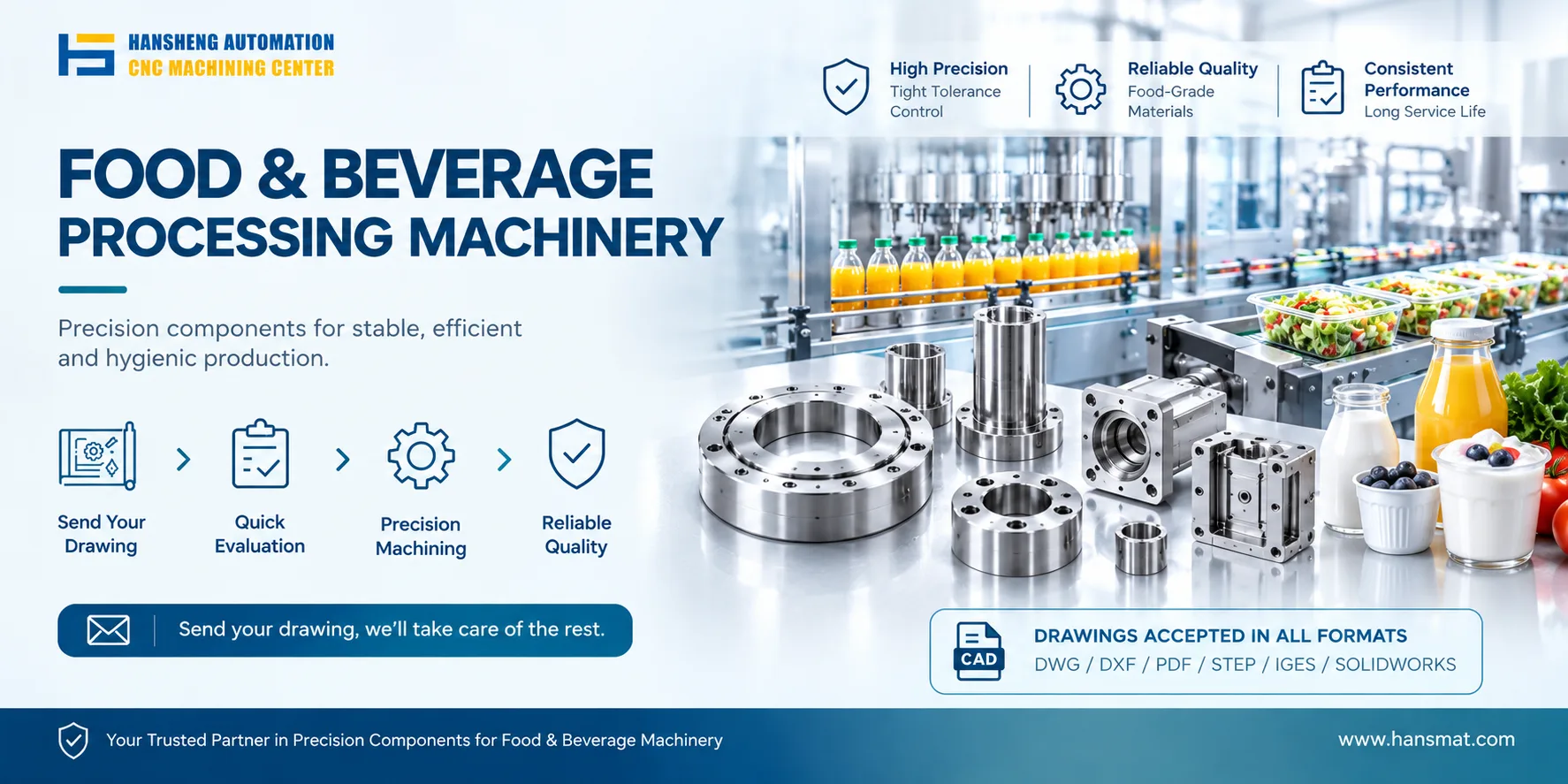
Hansheng Automation can machine replacement homogenizing valves, plungers, valve seats, and pump body parts from customer drawings, in single pieces or small batches.
Material preparation
Filtering: Pass the material through an 80 mesh or finer filter to remove hard particles and lumps. This protects the homogenizing head.
Temperature: Most food materials homogenize well at 40 to 60°C. Use a preheating tank to bring material into this range. This lowers viscosity and improves the homogenizing result.
Feed preparation: Use a food-grade centrifugal pump or screw pump. Set feed pressure to 0.1 to 0.15 MPa in advance. Avoid dry running or feed overload.
Operation
Pre-feed and purge: Start the feed pump. After material fills the homogenizing chamber, open the vent valve to release air. Close the vent valve when the outlet flows continuously without bubbles.
Pressure settings: Match homogenizing pressure to the product. For milk, use two-stage homogenization: first stage 15 to 25 MPa, second stage 3 to 5 MPa. For jam and plant protein drinks, pressure can be set at 20 to 30 MPa. Follow the process specification for each product.
Start the main unit: Slowly raise the main motor speed to the rated value. Confirm pressure is stable and there is no abnormal vibration or noise.
Monitoring: Inspect pressure, oil temperature, and cooling water flow every 15 minutes. If pressure fluctuates or a line leaks, stop the machine and release pressure before troubleshooting. Never remove any part while the system is under pressure. In food production, record operating parameters for product traceability.
Shutdown and cleaning
End of batch: After the current batch, stop the main motor. Keep the feed pump running for 5 to 10 minutes to purge residual material from the piping.
System shutdown: Stop the feed pump, close the cooling water valve, and disconnect main power.
Food-grade cleaning: Quickly remove the homogenizing chamber, piping, and product-contact parts. Rinse with food-grade hot water at 70 to 80°C. For stubborn residue, soak and brush with a food-grade neutral cleaner. Remove all material residue to prevent microbial growth.
Final steps: Wipe exterior stains, tidy piping and cables, and fill in the equipment operation and maintenance record.
Our precision component customization is not limited to homogenizer parts. We also machine parts for filling machinery, tobacco packaging machinery, medical device components, yacht precision components, RC car precision components, printing machinery, and food machinery. Hansheng Automation works from customer drawings and delivers one-off or batch parts to the required material, tolerance, and surface finish. Our scope is precision components, not complete machines.