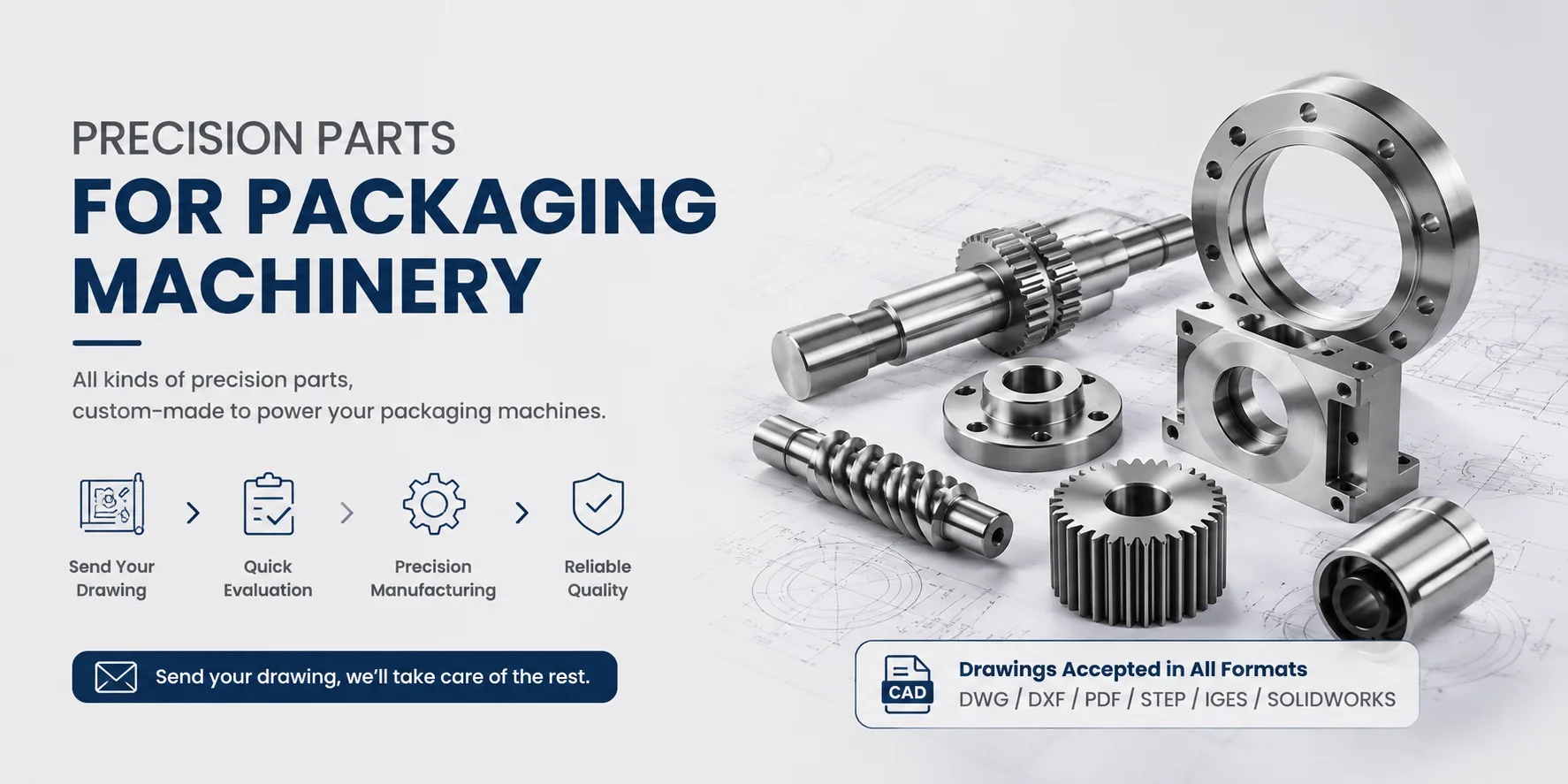
The accuracy of gears in a stretch film packaging machine directly affects operational stability, reliability, and service life. The key effects can be grouped into four areas.
1. Motion Accuracy: Ensuring Transmission Accuracy
Motion accuracy refers to the deviation between the actual rotational angle of the driven gear and the theoretical value, which must remain within allowable limits. If motion accuracy is insufficient, periodic angular error occurs during rotation, causing unstable film feeding speed and problems such as uneven stretching or sealing misalignment. In high-speed indexing mechanisms, angular error accumulates into positional deviation of the packaged product, affecting yield. Motion accuracy is usually evaluated through accumulated pitch error and radial runout, with tolerances set according to machine speed and gear ratio.
2. Working Smoothness Accuracy: Reducing Vibration and Noise
Working smoothness accuracy reflects the fluctuation of the instantaneous gear ratio, requiring minimal impact from tooth profile error and base pitch error. Tooth profile error can cause meshing jerkiness, leading to mechanical vibration and noise, and accelerating fatigue of bearings and shafts. In stretch film packaging machines, vibration may transmit to the sealing mechanism, causing heat-sealing temperature fluctuation and affecting seal quality. This accuracy is assessed by the variation range of the transmission ratio within one revolution, such as base pitch limit deviation. High-precision equipment often uses profile-modified gears to optimize meshing performance.
3. Contact Accuracy: Extending Gear Life
Contact accuracy refers to the uniformity of tooth surface contact area during meshing, usually measured by contact pattern percentage. Poor contact causes local stress concentration, leading to pitting, scuffing, and shortened gear life. In stretch film packaging machines, gears must withstand frequent start-stop cycles and stretching forces; insufficient contact accuracy accelerates wear and increases maintenance frequency. For high-speed light-load gears, the contact pattern should be distributed in the middle of the tooth height and evenly across the tooth width. For low-speed heavy-load gears, the pattern may be biased toward the tooth root to improve impact resistance. Contact can be optimized by adjusting center distance or lapping the tooth surface. For gears requiring specific contact patterns or profile modifications, Hansheng Automation can provide custom gear machining according to customer specifications.
4. Gear Pair Backlash: Preventing Seizure and Lubrication
Backlash is the normal clearance between non-working tooth flanks, used to accommodate thermal expansion, manufacturing errors, and lubricant storage. Too little backlash may cause seizure when gears expand or deform under load, leading to downtime or tooth fracture. Too much backlash creates impact and noise, and reduces transmission accuracy, such as reverse error. In stretch film packaging machines, backlash must account for both low-temperature lubrication needs and high-temperature expansion allowance. It is controlled through appropriate tooth thickness limit deviation and center distance limit deviation. Precision equipment often uses adjustable gearboxes to set backlash through shims.
Differentiated Selection of Accuracy Requirements
The four aspects of gear accuracy should be prioritized according to specific working conditions. High-speed transmission gears prioritize working smoothness accuracy, with strict control of tooth profile error and base pitch deviation. High-precision indexing gears prioritize motion accuracy, requiring reduced accumulated pitch error. Low-speed heavy-load gears prioritize contact accuracy, needing larger contact area and optimized tooth surface hardness. Through proper gear parameter design, high-precision machining processes such as gear grinding and honing, and strict inspection with coordinate measuring machines or gear testers, the overall performance of gears in stretch film packaging machines can be improved to support long-term stable operation.