Yes, swing-arm robots are typically designed with six axes. A six-axis swing-arm robot uses six joints to achieve movements similar to those of a human arm, covering a wide range of spatial positions and orientations.
The first axis enables horizontal rotation of the base, providing broad planar coverage. The second axis controls forward and backward swinging, expanding the horizontal working range. The third axis drives vertical movement of the main body, enhancing reach in the height direction. The fourth axis allows horizontal rotation of the wrist, changing the orientation of the end effector. The fifth axis adjusts wrist pitch to adapt to different working angles. The sixth axis rotates the end effector itself, enabling fine angular positioning and tool direction changes.
These coordinated movements make six-axis swing-arm robots suitable for welding, assembly, spraying, material handling, and other tasks that require multi-angle operation in three-dimensional space. The joints and connecting parts must maintain high dimensional accuracy, good wear resistance, and stable fit under repeated motion.
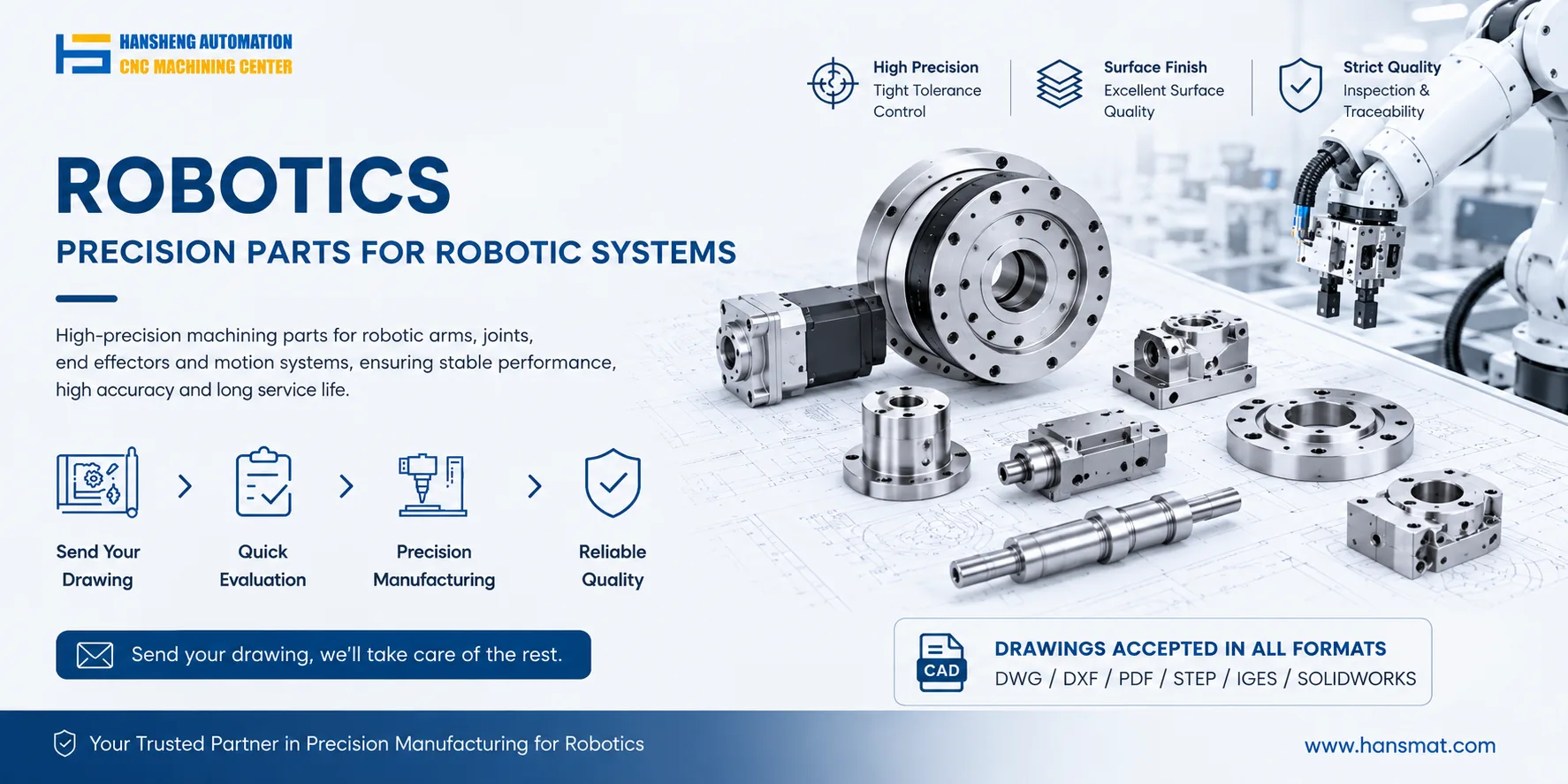
For these non-standard joint components, Hansheng Automation provides custom machining services based on customer drawings, supporting prototype development and small-batch production.