In film laminating machines, servo motors and stepper motors differ in six main areas: speed response, control accuracy, low-speed stability, torque-frequency characteristics, overload protection, and control mode.
Speed response
Stepper motor
A stepper motor takes longer to start. It usually needs 150 to 400 milliseconds to complete startup. This makes it hard to meet real-time requirements in high-speed lamination.
Servo motor
A servo motor responds very fast. It can reach target speed in a few milliseconds. It follows dynamic adjustment commands during lamination and improves production efficiency.
Control accuracy
Stepper motor
A stepper motor controls step angle through pulse signals. Cumulative error exists. After long operation, positioning accuracy drops. This can affect lamination position accuracy.
Servo motor
A servo motor uses a closed-loop control system. An encoder feeds back position information in real time. It can achieve micron-level control and keep the lamination position accurate.
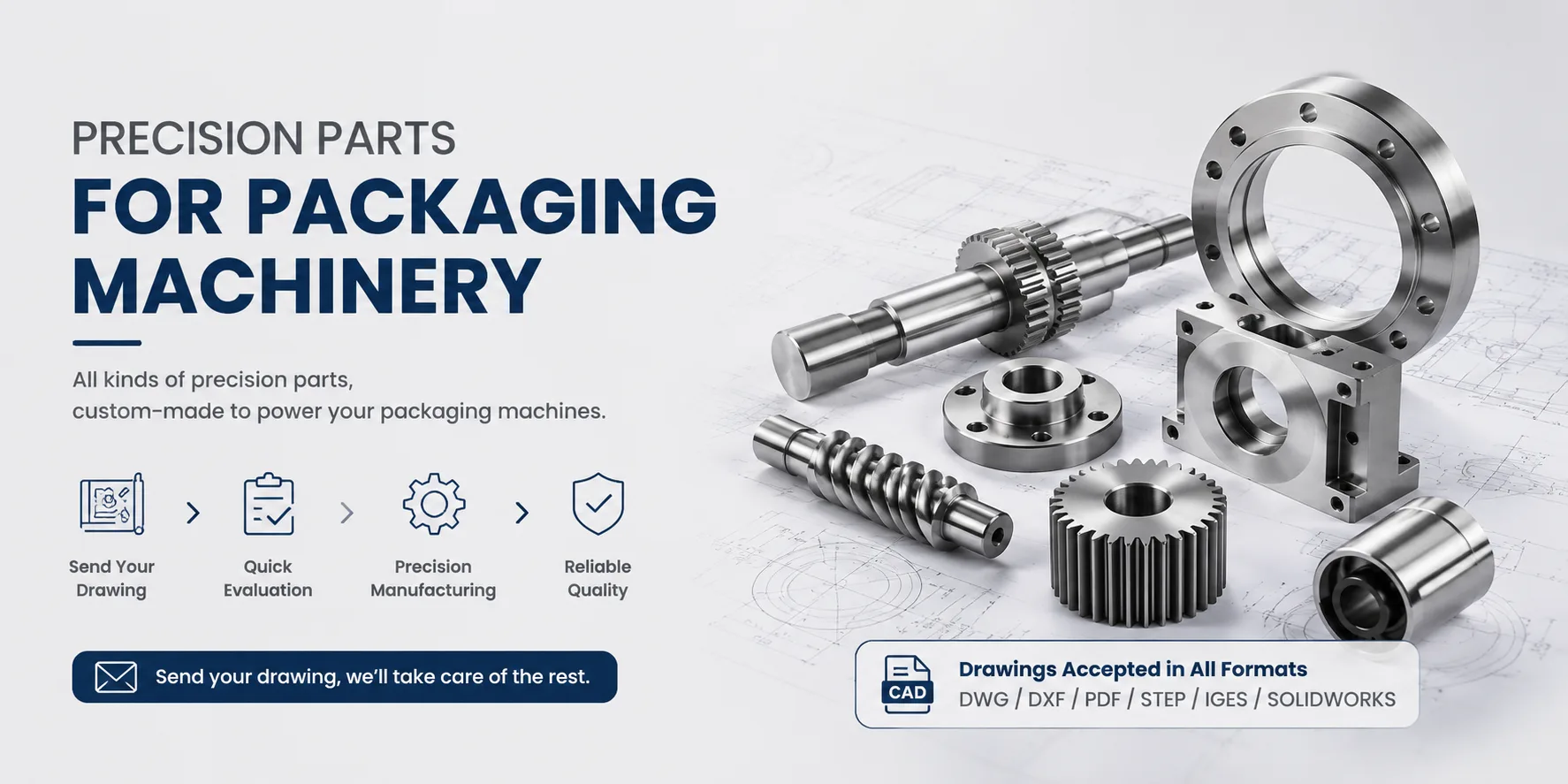
We can machine motor mounts, couplings, timing pulleys, and drive shafts for film laminating machines from customer drawings, in single pieces or small batches. Hansheng Automation works to drawing dimensions and assembly clearances.
Low-speed stability
Stepper motor
A stepper motor tends to produce low-frequency vibration at low speed. This can cause film flutter or offset during lamination and affect quality.
Servo motor
A servo motor runs smoothly across the full speed range. It maintains stable output even at low speed and avoids vibration that interferes with lamination accuracy.
Torque-frequency characteristics
Stepper motor
Stepper motor output torque drops clearly as speed rises. Torque falls sharply at high speed. Maximum speed is usually limited to 300 to 600 RPM. This makes it hard to meet high-speed lamination needs.
Servo motor
A servo motor provides constant torque output. It keeps torque stable within the rated speed range. It can provide enough power at high speed and meet multi-station coordinated operation needs in film laminating machines.
Overload protection
Stepper motor
A stepper motor has no overload protection mechanism. If load suddenly increases, it may stall and be damaged. This affects equipment stability.
Servo motor
A servo motor has built-in overload protection. It monitors current and torque in real time. When load exceeds the rated value, it adjusts output automatically. This avoids motor burnout and extends equipment service life.
Control mode
Stepper motor
A stepper motor uses open-loop control. It is driven directly by pulse signals. It can lose steps at high speed or under heavy load. An extra acceleration and deceleration curve is needed to avoid step loss. Control is more complex.
Servo motor
A servo motor uses closed-loop control. The drive samples motor position through an encoder in real time and corrects errors automatically. It keeps stable operation even when load changes. Control performance is more reliable.
Summary
In film laminating machines, servo motors are better suited to high-speed, high-precision lamination because of fast response, high accuracy, constant torque, and closed-loop control. Stepper motors cost less and fit simple lamination tasks with lower speed and accuracy requirements. Actual selection depends on equipment performance needs, budget, and maintenance cost.
Our precision parts machining service is not limited to film laminating machines. Hansheng Automation can machine custom parts from drawings for filling machinery, tobacco packaging machinery, printing machinery, and food machinery. We also cover yacht precision fittings and RC car structural parts. Single pieces and small batches are both available, with attention to material, tolerance, surface finish, and assembly fit.