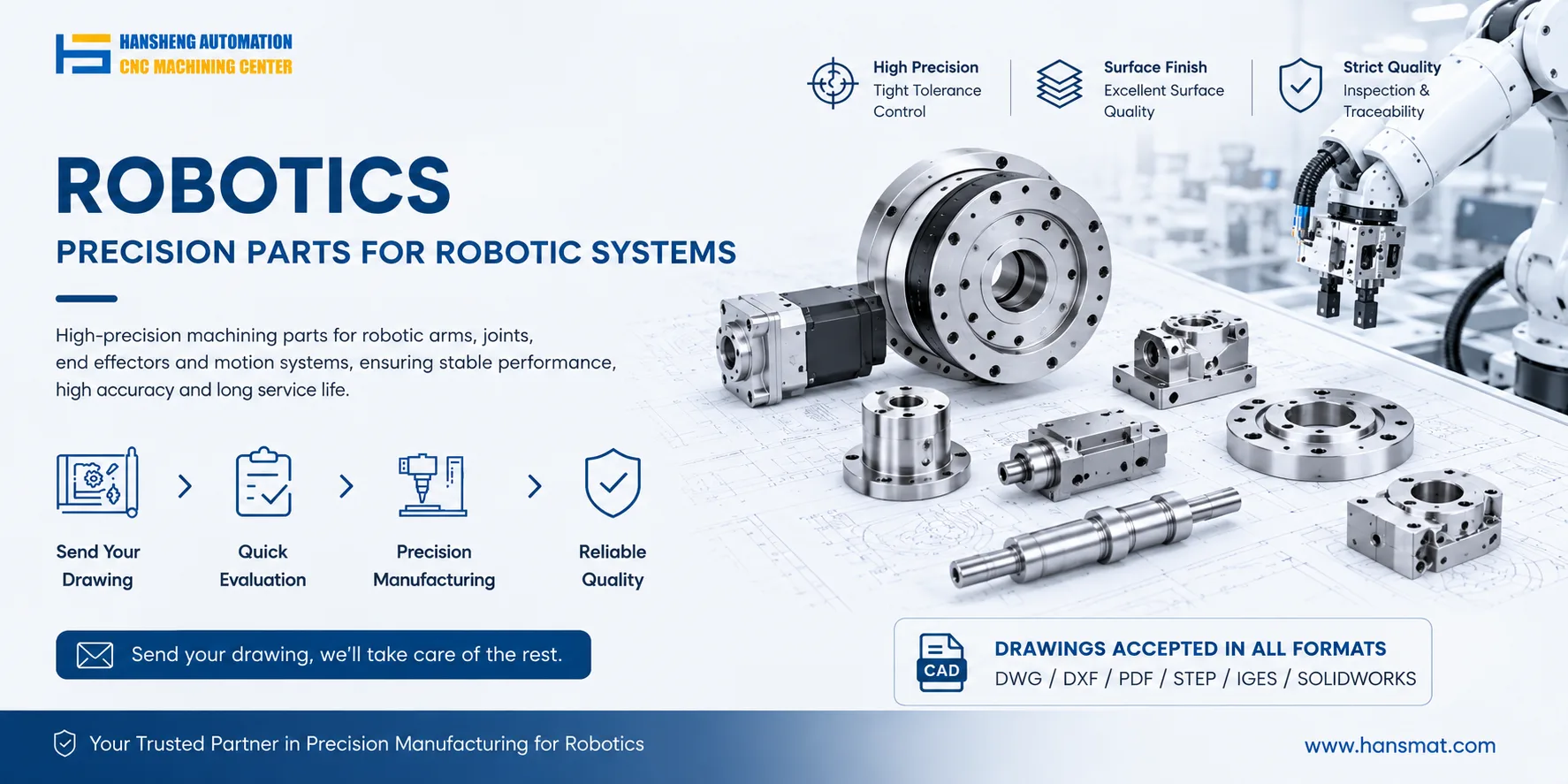
Robot transmission structures mainly include gear transmission, harmonic transmission, planetary gear transmission, belt transmission, chain transmission, worm gear transmission, linear transmission, and specially customized transmission. Different types are selected according to load, accuracy, space, and working conditions.
I. Gear Transmission
Gear transmission is the most widely used type in industrial robots and is further divided according to different transmission scenarios.
(A) Cylindrical Gear Transmission
Suitable for transmitting rotational power between parallel shafts. It offers accurate transmission ratio, high efficiency, and compact structure, covering light-load to heavy-load conditions. Many six-axis industrial robots use this type in shoulder and elbow joints, with accuracy up to grade IT6 or higher.
(B) Bevel Gear Transmission
Used for power transmission between intersecting shafts, mainly to change the rotation direction by 90°. It is commonly used in the wrist and shoulder of robots for direction-changing transmission.
(C) Rack and Pinion Transmission
Converts rotary motion into linear motion. It is often used in linear traveling axes of robots and linear feed mechanisms of heavy-duty handling robots.
II. Harmonic Transmission
Harmonic transmission is a core type of precision reduction transmission, consisting of a wave generator, flexspline, and circular spline.
Its main advantages include large reduction ratio, high transmission accuracy with repeatability up to ±0.01 mm, and compact structure without backlash. It is widely used in the joints of collaborative robots and precision assembly robots, providing high torque output in a small volume.
Its limitation is weak resistance to sudden impact loads, making it unsuitable for heavy-load applications with frequent impact.
III. Planetary Gear Transmission (Including RV Transmission)
(A) General Planetary Gear Transmission
Features a wide reduction ratio range, small size, and high torque density. It can achieve multi-stage reduction and torque amplification, making it a mainstream choice for heavy-duty industrial robots and palletizing robot arms.
(B) RV Transmission
An optimized type of cycloidal pinwheel planetary transmission. It offers higher load capacity, longer service life, and higher positioning accuracy, and is currently one of the mainstream precision transmission solutions for six-axis industrial robot joints.
IV. Belt Transmission
Belt transmission is divided into synchronous belt transmission and ordinary V-belt transmission.
(A) Synchronous Belt Transmission
Transmits power through meshing between belt teeth and pulley teeth, with no slippage, accurate transmission ratio, and low noise. It is often used in light-load high-precision transmission of robot forearms and wrists, or for remote power transmission between shafts.
(B) Ordinary V-Belt Transmission
Relies on friction to transmit power. It has strong shock absorption but the transmission ratio contains errors. It is only suitable for light-load auxiliary transmission in small service robots.
V. Chain Transmission
Chain transmission is divided into roller chain transmission and silent chain transmission.
(A) Roller Chain Transmission
Transmits power through engagement between rollers and sprockets. It has a simple structure and low cost, and is mostly used in the traveling mechanisms of ordinary heavy-duty handling robots.
(B) Silent Chain Transmission
Uses a toothed engagement structure, producing lower noise and smoother transmission. Its accuracy is better than roller chain, and it is mostly used in robot transmission applications requiring higher operating quality.
Overall characteristics of chain transmission: average transmission ratio is stable, and it can operate in harsh conditions such as dust and oil contamination. However, it has some impact and noise during operation, and its overall transmission accuracy is lower than gear transmission solutions.
VI. Worm Gear Transmission
Worm gear transmission is used for power transmission between crossed axes. It provides a large reduction ratio and has self-locking characteristics. When the worm is the driving member, it can prevent the load from back-driving.
It is commonly used in the reduction transmission of robot rotary tables and waist joints. Some small collaborative robots also use it for joint self-locking.
Its disadvantage is low transmission efficiency. It can generate significant heat at high speed and therefore requires a matching heat dissipation structure.
VII. Linear Transmission
Linear transmission directly achieves linear motion. Common types include:
(A) Linear Motor Transmission
Has no intermediate transmission components, offering fast response and high positioning accuracy. It is commonly used in high-speed dispensing robots and high-speed handling robots in the 3C industry.
(B) Ball Screw Transmission
Converts rotary motion into linear motion, with high transmission efficiency and stable positioning accuracy. It is often used in the linear axes of industrial robots and the feed mechanisms of CNC robots.
(C) Pneumatic/Hydraulic Linear Transmission
Uses compressed air or hydraulic oil to push a piston for linear motion. It provides large thrust and fast response, and is mostly used in heavy-duty handling robots and special operation robots.
VIII. Special Custom Transmission
Special transmission solutions are developed for specific working scenarios.
(A) Cable-Pulley Transmission
Transmits power through wire rope and pulleys. It is lightweight and flexible, mostly used in the joint transmission of biomimetic robots and lightweight service robots.
(B) Magnetic Transmission
Achieves contactless power transmission through a magnetic field, with no friction and no contamination. It is suitable for special robots used in cleanrooms and medical applications.
For these specialized transmission components and other non-standard parts, Hansheng Automation provides custom machining services based on customer drawings, supporting both prototype development and small-batch production.