Premade bag vacuum packaging machines commonly use five bag feeding methods: tray feeding, pull-down feeding, horizontal feeding, side suction feeding, and dual tray feeding. Different methods suit different bag types, thicknesses, and output requirements.
Tray feeding
Bags are placed in a tray. The tray is above the bag pickup unit. As the tray moves, it places bags above the pickup unit, which takes bags from the tray.
Advantages: A tray can hold more than 2,000 bags, enough for 1 to 2 hours of machine output. It has strong versatility. Bags only need to be arranged neatly in a flat tray, and bag thickness has little effect.
Disadvantages: Adding bags requires a stop of about 30 seconds. Workers can use this time to check bag seal quality and adjust the machine promptly.
Pull-down feeding
Suction plates hold the upper bag. After reaching the bag feeding position, the bag is pulled down.
Advantages: It can hold several hundred bags at a time and allows continuous adding, so the machine keeps working.
Disadvantages: It has requirements for bag thickness. Bags that are too thin or too thick are not suitable. The suction plates need low suction force to pick up bags, or output drops. If bags and suction plates are too thin, multiple bags may be picked up, causing waste. During operation, workers can add bags while preparing the machine to reduce workload.
Horizontal feeding
Depending on conveyor length, tens of thousands of bags can be placed horizontally on the conveyor. When the conveyor reaches the detection point, suction cups pull out the upper bag.
Advantages: Continuous feeding keeps operation running. Tens of thousands of bags can be placed at one time, and stability is strong. The feeding equipment costs less, the method is simple, manual operation is easy, and cost effectiveness is relatively high.
Disadvantages: The feeding equipment needs control, and maintenance is difficult. It suits thick bags such as flat aluminum foil bags. Soft bags do not curl easily.
Side suction feeding
This method is common on vertical packaging machines. Bags are placed vertically, with the lower surface curved and a gravity carriage on the rear surface. The gravity carriage helps the bag move down. Suction plates pull from the side, keeping the bag standing and shortening the distance between the bag and bag clamps.
Advantages: Speed is relatively slow, but operation is stable.
Disadvantages: Slow speed can affect overall packaging efficiency.
Dual tray feeding
The working principle is similar to tray feeding, but two trays work alternately.
Advantages: No need to stop during operation.
Disadvantages: The structure is complex, equipment cost is high, and versatility and cost effectiveness are relatively low.
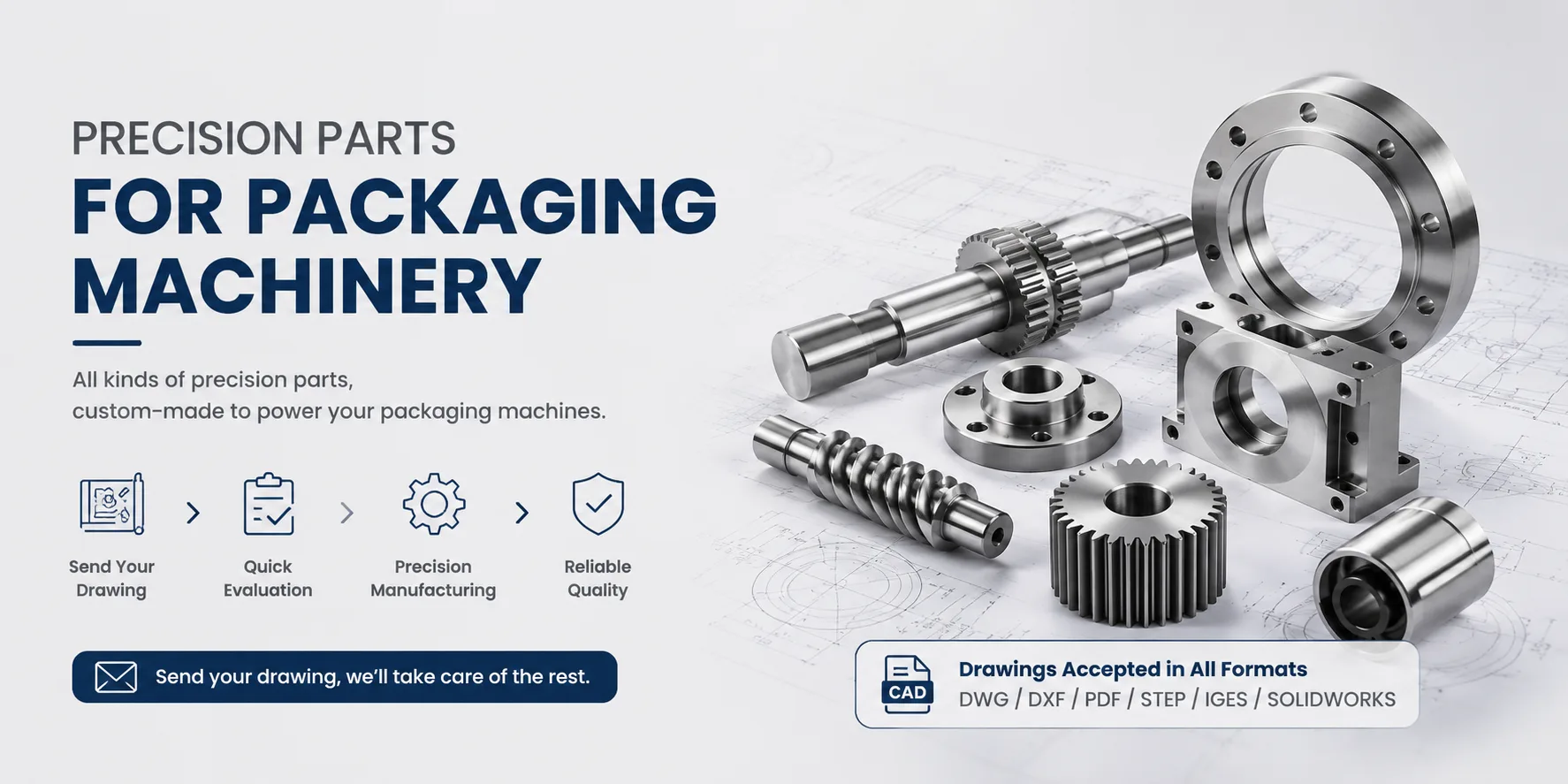
These bag feeding methods place different requirements on bag feeding suction cups, suction plates, clamps, trays, gravity carriages, side suction mechanisms, bag clamps, guide rails, links, and other parts. Hansheng Automation can precision-machine these packaging machinery parts in single pieces or small batches according to customer design drawings. We can use stainless steel, aluminum alloy, carbon steel, or engineering plastics, control tolerances to drawing requirements, and provide surface treatments such as anodizing, blackening, nickel plating, or powder coating.
Our custom precision machining capability is not limited to premade bag vacuum packaging machines. In addition to filling machinery parts and tobacco packaging machinery parts, we can machine yacht precision parts, RC car precision parts, printing machinery parts, food machinery parts, medical device parts, and feed packaging equipment parts according to drawings. After customers provide drawings, Hansheng Automation can support prototyping and batch production for non-standard parts.