

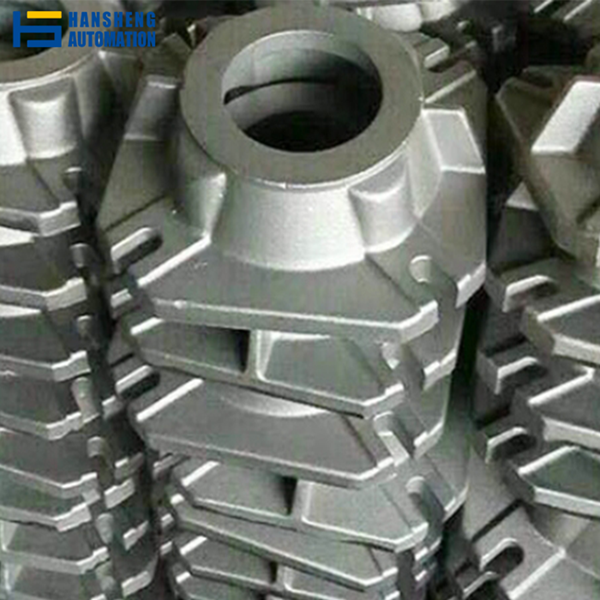

Hansheng Automation (Dongguan) Co., Ltd. is one of the most experienced manufacturers and suppliers of cast iron parts in China. If you're going to wholesale bulk cost-effective cast iron parts made in China, welcome to get pricelist and quotation from our factory. Also, customized service and OEM&ODM service are available.
Hansheng Automation offers more than just iron castings; this is just one small part of our casting services. As a Precision machinery parts manufacturer, we offer services such as gear manufacturing (ISO/DIN/GB level 5), precision CNC machining, precision castings (Specified Tolerance: ±0.03mm), and various FA parts. From prototyping to production and finishing, we provide a comprehensive, one-stop service, eliminating the need for customers to rely on third-party manufacturers.
what is Cast iron parts

Our Casting Capabilities
Cast iron parts are artifacts obtained through a series of casting processes and finishing treatments.They are customized parts produced according to different customer's drawings.There are two main types of cast iron parts that Hansheng Automation can provide, namely gray cast iron parts and ductile iron parts.The casting methods it can be adapted to include Sand Casting, Gravity Casting, Lost Foam Casting, etc.
Features of Cast Iron Part
Good abrasion resistance
As the composition of cast iron parts contains graphite, graphite itself has a good lubrication effect, so that the cast iron parts in the friction vice shows good wear resistance.
Good vibration damping
Graphite can effectively absorb the energy generated by vibration, so that cast iron parts have the performance of reducing noise and vibration transmission.
Low tool wear
When cutting cast iron parts, it can play a certain lubricating effect on the tool, and the tool wear is small when processing.
Material: Gray Iron vs. Ductile Iron
We help you choose the optimal material for your needs:
Gray Cast Iron (GCI)
Grades: HT200, HT250, HT300 (ASTM A48 Class 25, 30, 35)
Key Properties:
Excellent vibration damping (up to 3x that of steel).
Good machinability at a lower cost.
High compressive strength.
Typical Applications: Machine tool beds, bases, housings, pump casings, brake drums, engine blocks.
Ductile Iron (DI / Nodular Iron)
Grades: QT400-18, QT450-10, QT500-7 (ASTM A536 Grade 65-45-12, 70-50-05, etc.)
Key Properties:
High tensile strength and ductility, approaching that of steel.
Superior impact and fatigue resistance.
Good wear resistance and corrosion resistance.
Typical Applications: Hydraulic manifolds, valve bodies, crankshafts, gears, automotive components, heavy equipment parts.
A more detailed comparison of the two materials
In order to better compare the difference between the two materials we use, ductile iron and gray cast iron, I will look at both material composition and material properties.
Below are the types of cast iron materials we commonly use and their basic compositions
| Cast iron type | Carbon (C) | Silicon (Si) | Manganese (Mn) | Sulfur (S) | Phosphorus (P) | Common Grade |
| Grey Cast Iron | 2.5-4.0 | 1.0-3.0 | 0.2-1.0 | 0.02-0.25 | 0.02- 1.0 | HT 250, HT 300 |
| Ductile Cast Iron | 3.0 -4.0 | 1.8-2.8 | 0.1-1.0 | 0.01- 0.03 | 0.01-0.1 |
QT 200 |
Characterization between Gray Cast Iron and Ductile Iron
| characterization | gray cast iron | ductile iron |
|---|---|---|
| Graphite morphology | sheet | orbicular |
| Strength/Toughness | Low strength, low toughness, brittle | High strength, high toughness |
| damping | excellent | Good (better than steel, not as good as gray cast iron) |
| abrasion resistance | Good (especially lubricated) | favorable |
| Casting Performance | Excellent (good flowability, low shrinkage) | Good (good fluidity, greater shrinkage) |
| processing performance | outstandingly good | favorable |
| costs | Low | high |
| process requirement | relatively simple | Rigorous (spheroidization, gestation treatment) |
Technical Specifications & Tolerances
Typical Tolerances: Dimensional tolerances of CT8-CT10 (as per GB/T standards) or equivalent ISO/ASTM.
Surface Roughness: Achievable roughness of Ra ≤ 12.5 μm after machining.
Hardness: Typically 180–250 HBW for Gray Iron, adjustable for Ductile Iron.
Technical Requirements and Core Composition
The graphite form (flake/spherical) directly influences the tensile strength (250-600MPa) and elongation (1-10%), using HT250/HT300 gray cast iron or QT450-10 ductile iron.
Sand/lost foam casting guarantees dimensional tolerances (CT8-CT10), surface roughness Ra ≤ 12.5 μ m, and can processing complicated internal hollow shapes.
With a steady hardness of 180–250HBW, heat treatment is either normalizing or annealing to release internal stress.

Industries We Serve
Our custom cast iron parts are trusted by leading companies in:
Machine Tool Manufacturing (e.g., CNC machine bases, structural components)
Hydraulic & Pneumatic Systems (e.g., manifold blocks, valve bodies)
Automotive & Transportation (e.g., engine parts, chassis components)
Construction & Agriculture (e.g., heavy equipment housings, structural parts)
Pump & Valve Industry


FAQ
Q: How should I choose between gray iron castings and ductile iron castings? What applications are each suitable for?
A: Gray iron castings (common grades HT250 and HT300): Graphite is flaky, offering advantages such as excellent vibration damping (preferred for machine tool beds, with a vibration damping coefficient three times that of steel), excellent machinability, and low cost. However, this type of castings has lower strength and toughness. Suitable for static load-bearing applications with high vibration damping requirements, such as machine tool beds, general equipment supports, and brake discs (stable friction coefficient).
Ductile iron castings (common grades QT200 and QT450-10): Graphite is spherical, offering advantages such as high strength (tensile strength 250-600 MPa) and good toughness. However, this type of castings is more expensive and requires spheroidizing/inoculation (a demanding process). Suitable for dynamic loads and high pressures, such as hydraulic valve blocks (pressure resistance 35 MPa+), diesel engine transmission components, and ship load-bearing components.
The choice depends on which option is most suitable and cost-effective.
Q: What kind of cast iron parts are suitable for sand casting, gravity casting, and lost foam casting?
A: Sand casting: A mature process with moderate cost, suitable for small to medium-sized batches of simple castings.
Gravity casting: High molding stability, suitable for mass production of castings with uniform wall thickness.
Lost foam casting: Its core advantage is its ability to process complex internal cavity structures (such as special-shaped hydraulic valve blocks and integrated components with pre-drilled holes), and its excellent surface finish (helping to reduce subsequent finishing work). It is designed specifically for customized, special-shaped parts.
Q: Why are cast iron parts preferred over steel or other materials for machine tool beds and diesel engine cylinder blocks?
A: Regarding machine tool noise, cast iron contains graphite, which actively absorbs vibration energy. Its damping coefficient is three times that of steel, significantly reducing vibration errors during machining and ensuring machine tool accuracy. Furthermore, tool wear during cast iron machining is reduced (graphite lubricates the tool), resulting in lower machining costs compared to steel. For diesel engine cylinder blocks, cast iron offers excellent heat and fatigue resistance, allowing it to withstand high-temperature cyclic loads (avoiding deformation and cracking). Steel, on the other hand, is susceptible to fatigue failure at high temperatures. Furthermore, cast iron is cheaper than steel of comparable performance, offering a more cost-effective solution.
Q: What are the irreplaceable advantages of choosing Hansheng Automation for iron castings? Do you offer full-process service?
A: We offer a one-stop solution, covering the entire process from "drawing analysis → material selection → casting → finishing → quality inspection → delivery," eliminating the need for customers to work with multiple suppliers.
Furthermore, we have a professional technical team that can customize processes to meet your specific needs. As a source factory, we guarantee quality and manage delivery times.
Hot Tags: cast iron parts, China cast iron parts manufacturers, suppliers, factory, casting specification, casting vent, casting sprue, casting export, casting inspection, construction casting


