


In high-speed automated production lines-such as tobacco packaging and electronics assembly-cam indexers execute tens of thousands of indexing cycles daily. Each cycle is a rigorous test of precision.
During procurement, equipment manufacturers typically fixate on factory-calibrated precision. While undeniably important, the true differentiator lies elsewhere: can this precision be sustained within acceptable tolerances after prolonged, high-frequency operation?
Once accuracy degrades, it triggers a costly chain reaction: indexing deviations, station misalignments, declining yield rates, and prolonged downtime for recalibration.
So, why does precision inevitably degrade over time? And how does Hansheng address this issue fundamentally at its source?
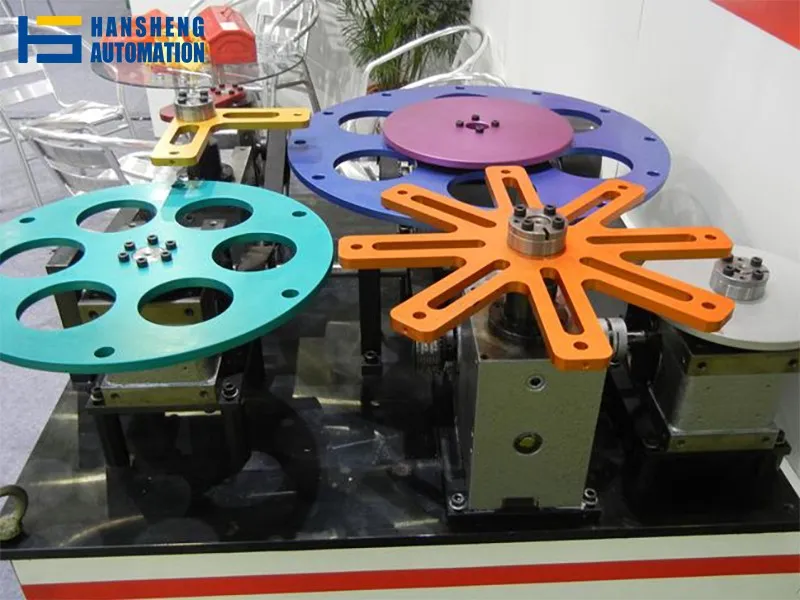
The Root Cause of Precision Degradation: Contact Interfaces
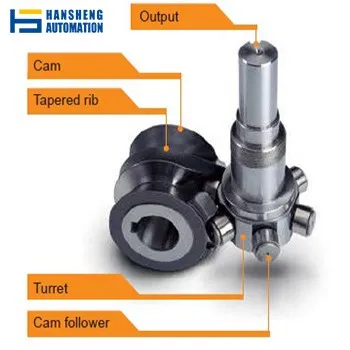
The precision of a cam indexer fundamentally hinges on the high-frequency, high-stress contact between the cam profile and the roller followers. In cases of inadequate surface hardness, prolonged rolling contact fatigue inevitably induces microscopic wear. As this wear accumulates, it causes the cam profile to progressively deviate from its nominal design geometry. Once the profile distorts, indexing accuracy inherently declines.
While surface hardness serves as the first line of defense against this wear mechanism, whether this hardness translates into actual operational longevity is entirely dictated by foundational metallurgy: material selection and heat treatment processes.
Advanced Case Hardening Process: Carburizing, Quenching, and Low-Temperature Tempering
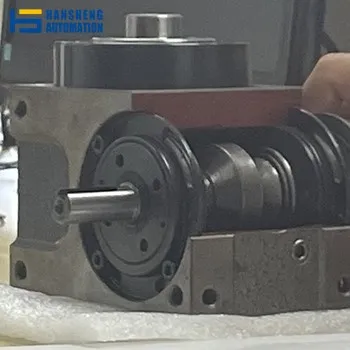
The cam bodies of Hansheng indexers are engineered from high-grade low-carbon alloy steel. While its inherent surface hardness is limited, this specific low-carbon composition is the optimal candidate for the carburizing process. Post-carburizing, the surface carbon concentration is drastically elevated-laying the foundation for extreme hardness during subsequent quenching-while the core inherently preserves its superior toughness.
Carburizing (Approx. 900–930°C)
Active carbon atoms are diffused into the surface layer, elevating the carbon content from low to high. By precisely controlling the carburized case depth, this step establishes a robust "carbon reserve," an absolute prerequisite for achieving ultra-high surface hardness.
Quenching
Through rapid cooling, the surface layer undergoes a phase transformation into a dense martensitic microstructure, achieving a Rockwell hardness of 58–62 HRC. Simultaneously, the low-carbon core remains ductile. This creates an engineered "hard case, tough core" architecture: the hardened exterior exceptionally resists rolling contact fatigue, while the ductile interior effectively absorbs operational shock loads.
Low-Temperature Tempering (150–200°C)
As the critical finishing step in the metallurgical workflow, low-temperature tempering relieves residual stresses induced by quenching. This ensures long-term dimensional stability, permanently locking in the cam's precision geometry.
What Underpins Hansheng's Sustained Precision?
End-to-End Manufacturing Synergy
Sustained accuracy in Hansheng cam indexers relies on more than just advanced surface hardening; it is the direct result of deep synergy across the entire manufacturing value chain.
Pre-Heat Treatment Precision Machining
Heat treatment cannot compensate for sub-standard machining. Prior to surface hardening, Hansheng utilizes proprietary in-house precision machining to lock the baseline cam profile geometry within exceptionally tight tolerances:
- Precision Grinding: ±0.005 mm
- Superfinishing (Mirror Finish): ±0.002 mm
Minimizing surface roughness maximizes profile fidelity post-heat treatment. Flawless pre-machining precision is the absolute prerequisite for an effective thermal processing cycle.
Foundational Casting Capabilities
Hans maintains versatile in-house casting operations, including advanced sand casting and lost-foam casting. This enables tailored process selection right from the design phase, guaranteeing inherent dimensional stability in the raw castings and establishing a robust foundation for downstream precision machining.
Rigorous Dual-Gate Inspection Protocol
- Post-Heat Treatment Verification: Confirms that thermal processing has introduced zero out-of-tolerance distortion, rigorously validating intermediate process quality.
- 100% Final Outbound Inspection: Every individual indexer undergoes comprehensive testing to verify absolute compliance with stringent performance standards prior to shipment.
Benchmark Application: Tobacco Packaging Machinery
This operational environment is notoriously unforgiving, characterized by continuous high-speed runs and extremely high-frequency indexing cycles. Furthermore, these packaging lines are hyper-sensitive to precision repeatability. Even microscopic indexing deviations can trigger station misalignment, directly compromising final production yield and line efficiency.
Leveraging the ultra-hard cam profiles achieved through our advanced case hardening process, Hansheng indexers effectively mitigate rolling contact fatigue (RCF) and cumulative wear. This engineered resilience ensures that uncompromising indexing accuracy is sustained, even under relentless, high-cycle operational stresses.
Precision Specifications
- Standard Accuracy Grade: ±30 arc-sec
- Custom High-Precision Grade: Up to ±15 arc-sec
Industry-Specific Customization Capabilities
Beyond standard configurations, Hansheng offers deep-level engineering customization tailored to diverse industrial sectors. We seamlessly align with bespoke application requirements, providing highly configurable parameters that encompass accuracy grades, mounting footprints, number of stops (stations), and dynamic motion curves.
End
The sustained precision of Hansheng cam indexers is not the byproduct of isolated process optimizations; rather, it is the culmination of seamless synergy across our entire manufacturing value chain:
Premium Material Selection → Precision Casting → High-Tolerance Machining → Advanced Case Hardening → Post-Treatment Dimensional Verification → 100% Final Outbound Inspection
Every single phase is meticulously engineered to safeguard ultimate indexing accuracy. This embodies Hansheng's fundamental commitment to OEMs and equipment builders: we do not merely supply components that pass initial factory specs. We deliver robust, precision motion-control mechanisms engineered to withstand the rigorous test of time and continuous operation.
To explore detailed technical specifications of Hansheng cam indexers, or to discuss bespoke component requirements for your specific applications, please connect with our engineering team today.
marketing@hansmat.com