

Finding a reliable custom non-standard parts manufacturer often requires a comprehensive evaluation of multiple factors, including manufacturing capabilities, lead times, quality control, intellectual property (IP) protection, and supply chain stability.
For engineers, product designers, and procurement teams, the following questions typically arise during the early stages of a project:
- Will my design files be accurately understood?
- Can the supplier protect my design confidentiality?
- Is low-volume or even one-off production supported?
- How long will prototyping and mass production take?
- How can I ensure that the parts meet the design specifications?
Based on the real-world inquiries Hansheng Automation has received while working with global clients, we have compiled the most common questions in custom parts manufacturing. Below are the detailed answers to help you advance your project development and production more efficiently.
Frequently Asked Questions
What drawing formats do you accept?
We support a wide range of industry-standard file formats:
3D Models (for toolpath programming and cost estimation): STEP (.step, .stp), IGES (.iges, .igs), SolidWorks (.sldprt), or Parasolid (.x_t).
2D Drawings (for specifying tolerances, technical requirements, and surface finishes): PDF, DWG, or DXF.
Our Recommendation: We highly recommend providing both a 3D model and a 2D drawing with critical tolerances marked. This helps our engineering team accurately interpret your design intent and provide a more precise quotation.

How do you protect my design files and intellectual property (IP)?
We take our clients' intellectual property (IP) protection very seriously. We are more than happy to sign a Non-Disclosure Agreement (NDA) before you share any drawings or project details with us.
Internally, we implement strict data security and access control policies. This ensures that your design files are only accessible to authorized personnel and are used solely for evaluation and manufacturing purposes, with absolutely no disclosure to any third party.
Do you have a Minimum Order Quantity (MOQ) requirement for custom parts?
We offer flexible manufacturing solutions to support your needs at every stage, from prototyping and low-volume trial runs to mass production.
We understand that at the beginning of a project, clients typically require:
A single prototype/sample for assembly validation;
A low-volume batch to test market feedback;
A gradual transition to scaling up production later on.
Because of this, Hansheng Automation does not impose strict MOQ requirements. Whether you need a single functional prototype, a small batch of parts, or long-term high-volume production, we can provide the manufacturing support tailored to your specific project needs.
Do you offer prototyping services?
For projects that meet our evaluation criteria, we can provide prototyping support and assist in reducing sample development costs based on the potential of the project collaboration.
The specific support offered is evaluated comprehensively based on part complexity, subsequent production plans, and the overall scope of collaboration. If you have a design that needs validation, please feel free to contact our engineering team for a project evaluation.


How long does it take to manufacture custom part samples?
The manufacturing lead time depends on part complexity, material, quantity, and post-processing requirements.
For prototyping and sample manufacturing:
Simple structures: approximately 3–5 working days;
Complex structures or parts requiring special surface treatments: approximately 7–10 working days.
For production batches: The lead time is typically 2–4 weeks.
The exact schedule is determined by factors such as part quantity, material sourcing cycles, machining process complexity, and surface treatment requirements. Prior to production, we will confirm a detailed delivery schedule and keep you updated on progress.
How do you ensure the dimensional accuracy and quality of custom parts?
Quality is at the core of our manufacturing. Our Quality Control (QC) team strictly executes the following inspection processes:
First Article Inspection (FAI): Ensures that equipment setup and machining parameters fully align with the drawing requirements.
In-Process Quality Control (IPQC): Conducts real-time random inspections during production to prevent batch deviations.
Outgoing Quality Control (OQC): Performs a final check on dimensions and surface quality for all finished products before packaging.
Upon request, we can provide a dimensional inspection report and Material Test Report (MTR) along with your shipment.
What is your after-sales policy if I discover quality issues upon receiving the parts?
If out-of-tolerance dimensions, material discrepancies, or cosmetic defects are indeed caused by our machining, inspection, or packaging stages, we will rework or remake the parts for you and cover the associated costs.
If the issue arises from communication misunderstandings or design interference, we will also actively cooperate to help analyze the problem and offer optimization suggestions. We respond to all after-sales inquiries within 24 hours and provide a solution within 3 working days.


What payment terms do you support?
We support flexible business-to-business (B2B) payment methods. Typically, we require a 30%–50% deposit upon contract signing, with the remaining balance paid before shipment. For long-term partners or qualifying projects, we can discuss more flexible payment terms. All transactions are completed through official corporate accounts.
What materials can you machine, and do you keep stock of common materials?
We have extensive experience in machining metals and engineering plastics. Our commonly used materials include:
Aluminum Alloys: 6061, 7075, 5052, etc.
Stainless Steel: 303, 304, 316L
Titanium Alloys: TC4/Gr5, as well as copper alloys.
Engineering Plastics: POM (Acetal), Nylon, PEEK, ABS.
We maintain stable supply channels for common materials to shorten procurement lead times. Special material grades can also be sourced upon request, with Material Test Reports (MTR) delivered with the shipment.
What machining accuracy (tolerances) can you typically guarantee?
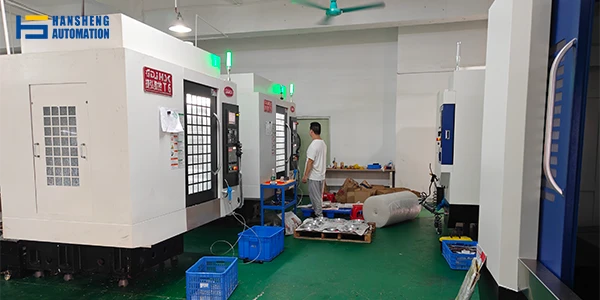
We utilize high-precision CNC equipment (such as the Kashifuji Gear Skiving Machine KPS30, Taesin TXC-T6, Seibu Wire EDM M50B, etc.). Our standard machining tolerances can be consistently controlled within ±0.01 mm to ±0.02 mm.
For precision-fit components, we can achieve tolerances down to ±0.005 mm through process optimization. We will evaluate specific tolerance levels based on your 2D drawings before quoting, ensuring our manufacturing capabilities align with your design requirements.
About Hansheng Automation
Hansheng Automation specializes in the manufacturing of high-precision custom parts and precision reducers, providing global clients with one-stop manufacturing services ranging from product development and sample validation to low-volume and mass production.
Leveraging our extensive CNC machining experience, robust quality management systems, and dedicated engineering support, we help clients reliably transform their designs into physical products. Whether you need to prototype a single component or are seeking a long-term, stable manufacturing partner, you are welcome to submit your drawings and project requirements to our engineering team.