


Hansheng Automation (Dongguan) Co., Ltd. is one of the most experienced manufacturers and suppliers of cam indexing table for conveyor in China. If you're going to wholesale bulk cost-effective cam indexing table for conveyor made in China, welcome to get pricelist and quotation from our factory. Also, customized service and OEM&ODM service are available.
In the field of precision parts and reducer manufacturing, Hansheng Automation has a professional solution team that has focused on the production of Cam Indexer Table for many years and has accumulated rich experience. Below, I will explain to you from three aspects: what is Cam Indexing Table For Conveyor, how it works, and where it is used. If you have related equipment needs, please feel free to contact us! We have provided a series of reducer products such as Cam Indexer, Harmonic Drive, Hollow Rotary Reducer, and planetary Gearbox for Huawei, BYD and other companies. The quality is trustworthy.
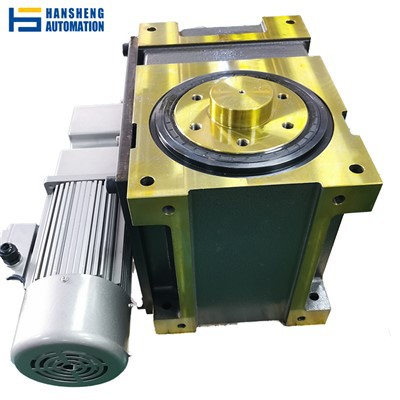
High-Rigidity Flange Drive for Precision Intermittent Automation
The DF Series Flange Type Cam Indexer features a heavy-duty output flange and an integrated center bore, making it the ideal drive unit for linear intermittent conveyor systems (link conveyors, timing belt lines) as well as direct-mounted rotary dial tables.
1. Direct Flange Mounting Interface
The integrated flange design allows direct connection to sprockets, timing pulleys, gears, or dial plates without requiring external shaft couplings. This eliminates coupling deflection, minimizes rotational inertia, and maximizes torsional stiffness.
2. Preloaded Cam Follower Mechanism (Zero Backlash)
Equipped with precision-ground globoidal cams and preloaded needle roller cam followers. The constant dual-point contact eliminates backlash across both dwell and indexing strokes, preventing product tipping and mechanical vibration during high-speed cycle starts and stops.
3. Universal 6-Surface Housing Mounting (VW 1–6)
All six faces of the rigid cast iron housing are precision-machined with standardized mounting holes, allowing horizontal, vertical, upside-down, or side mounting to match any conveyor frame or automated machine chassis.
4. Broad Input Speed Capability (Up to 800 RPM)
Engineered with high-grade alloy steel components and balanced kinematics, the DF series safely supports input shaft speeds from 5 to 800 RPM, offering flexible integration with continuous or start-stop motor drives.
DF Series Technical Specifications & Model Comparison
| Model | Matched Motor Power (kW) | Hollow Shaft Dia. (mm) | Permissible Radial Load (kgf) | Permissible Axial Load (kgf) | Indexing Accuracy (Arc Sec) | Weight (kg) | Standard Stations (Stops) | Input Speed Range (RPM) |
| 45DF | 0.06 / 0.09 | Ø8 | 130 | 140 | ±30 | 7.0 | 2, 3, 4, 5, 6, 8, 10, 12, 15, 16, 20, 24, 30, 32, 36, 40, 48 | 5 – 800 |
| 60DF | 0.09 / 0.12 | Ø16 | 140 | 142 | ±30 | 13.0 | ||
| 70DF | 0.12 / 0.15 | Ø20 | 220 | 300 | ±30 | 18.0 | ||
| 80DF | 0.15 / 0.2 | Ø30 | 330 | 420 | ±30 | 32.0 | ||
| 110DF | 0.4 / 0.75 | Ø40 | 560 | 700 | ±30 | 65.0 | ||
| 140DF | 0.75 / 1.5 | Ø50 | 760 | 1,000 | ±30 | 90.0 | ||
| 180DF | 1.5 / 2.2 | Ø60 | 1,200 | 1,500 | ±30 | 220.0 | ||
| 250DF | 2.2 / 3.7 | Ø80 | 3,200 | 4,150 | ±30 | 685.0 |
Notes:
- Mounting Positions: Supports all 6 housing orientations (VW 1 through VW 6). Specify your mounting direction when ordering so we can position the oil level sight glass, oil fill plug, and drain plug accordingly.
- High-Speed Inquiries: When operating above 400 RPM with high inertial loads, please contact our technical team for cam profile optimization (such as Modified Sine or Modified Constant Velocity curves).
Engineering Sizing & Selection Guide for Conveyors and Rotary Tables
Selecting the correct DF series indexer depends on whether it drives a linear conveyor (timing belt / precision chain) or a direct-mounted rotary dial table. Follow these 4 engineering evaluation steps:
Selection Workflow:
Step 1: Motion Profile & Station/Pitch Count -> Step 2: Total Equivalent Inertia Calculation -> Step 3: Radial & Axial Load Verification -> Step 4: Motor & Reducer Integration
Step 1: Define Pitch, Stations, and Cycle Timing
For Conveyor Drives: Determine pitch length per index cycle, total chain/belt length, number of carrier fixtures, and index time vs. dwell time.
For Rotary Dial Drives: Select the required station stops (e.g., 4, 6, 8, 12 stops) and indexing angle (e.g., 120°, 180°, 270°).
Step 2: Calculate Total Equivalent Inertia and Dynamic Torque
Conveyor Drive Inertia Formula:
Total Equivalent Inertia (J) = Sprocket/Pulley Inertia + (Total Mass of Chain, Fixtures and Workpieces * Pitch Radius Squared)
Rotary Dial Inertia Formula:
Total Inertia (J) = Dial Plate Inertia + Fixture Inertia + Workpiece Inertia
Verify Dynamic Torque (Td):
Calculate maximum acceleration torque based on equivalent inertia (J), cam angular acceleration factor, and input speed. Ensure dynamic torque does not exceed the model's output rating.
Step 3: Verify Radial and Overhung Load Capacities
Belt/Chain Tension (Radial Load Fr): Calculate the driving tension exerted by the conveyor chain or belt onto the output flange bearing. Ensure the total force remains within the Permissible Radial Load limit (from 130 kgf up to 3,200 kgf).
Thrust/Pressing Force (Axial Load Fa): If vertical clamping or pressing occurs at the indexing station, verify that downward force is within the Permissible Axial Load limit.
Step 4: Match Motor, Reducer, and Safety Clutch
Drive Motor: Match required motor power (0.06 kW to 3.7 kW) based on friction torque and index acceleration power.
Torque Limiter: For conveyor applications prone to carrier jams, we recommend pairing the DF indexer with a Hansheng safety torque limiter on the output flange or input shaft.
How does This Product work?
Its working principle is based on the fit of the cam's contour curve and the indexing disk. When the cam is rotated by the driving device, the contour curve of the cam interacts with the rollers or grooves on the indexing disk to produce intermittent rotation of the indexing disk. During the rotation of the indexing disk, each station arrives at a specified position in turn to complete operations such as material conveying, processing or assembly.
Specifically, in the rising curve stage of the cam, the cam pushes the roller on the indexing disk, so that the indexing disk starts to rotate; when the cam turns to the base circle part, the indexing disk stops rotating, and at this time, it can carry out operations such as material processing or assembly; when the cam turns to the rising curve stage again, the indexing disk starts to rotate again. Through this cycle, it realizes the accurate indexing and conveying of materials between different working stations.
What are the similarities and differences between the Parallel Dial Index Drives and the Parallel Dial Index Drives in terms of working principle?
Parallel Dial Index Drives are also indexing devices, which transmit power to the indexing table through a parallel structure of drive components to achieve precise indexing positioning. The Cam Indexing Table for Conveyor utilizes the special profile of the cam to achieve intermittent rotation of the indexing table. Both of them are different in the way of realizing indexing movement, but both of them pursue high accuracy and high stability of indexing effect to meet the needs of industrial production.
Application areas
Precision Link & Timing Belt Conveyors
Directly mounts drive sprockets or timing pulleys on the output flange to achieve synchronized, vibration-free intermittent linear transfer for assembly pallets.
01
Rotary Assembly & Fastening Machines
Directly couples medium-diameter dial plates for multi-station screwdriving, riveting, pressing, and ultrasonic staking.
02
Pharmaceutical & Medical Device Packaging
Provides accurate, clean indexing for blister pack feeding, syringe assembly lines, and continuous cartoning machines.
03
Cosmetic & Beverage Filling Lines
Prevents fluid splashing and bottle toppling during high-speed intermittent transfer, capping, and labeling operations.
04
Automated Testing & Optical Inspection Systems
Delivers rigid ±30 arc-sec dwell accuracy for vision inspection cameras, laser marking stations, and electrical probing fixtures.
05

FAQ
Q: Why is the DF series preferred for intermittent conveyor drives?
A: The DF series features a rigid output flange face and high permissible radial load capacity (up to 3,200 kgf on the 250DF). This allows engineers to bolt driving sprockets or timing pulleys directly to the flange without additional external bearing pillow blocks, saving machine footprint and eliminating drive backlash.
Q: What is the significance of the 6-surface universal mounting (VW 1–6)?
A: All six faces of the DF housing are precision-machined with identical datum planes and threaded mounting patterns. This allows engineers to mount the unit flat on a table, vertically on a machine wall, upside down beneath a conveyor frame, or sideways without custom mounting brackets.
Q: Can Hansheng supply customized drive packages and CAD models?
A: Yes. We deliver fully integrated drive packages, including three-phase AC induction motors, brake motors, worm/helical gearboxes, safety torque limiters, and proximity sensor cams. Standard 2D PDF/DWG drawings and 3D STEP files are available for all 45DF–250DF models upon request.
Q: Can the positioning accuracy of the cam indexing table be maintained for a long time? Will there be deviations after long-term use?
A: It can be maintained for a long time. The core components of the equipment (cam, indexing plate) are made of high-strength cast iron/304 stainless steel. The cam profile is precision ground (error ≤ 0.005mm), and the self-lubricating bearing design ensures that the positioning accuracy remains within ±0.01mm after 20,000 hours of continuous operation. Daily cleaning and lubrication only need to be done every 6 months, without complex debugging, which greatly reduces the risk of accuracy attenuation.
Q: How long is the warranty period?
A: We provide a 20-month warranty period. During this period, if there is a problem with the product, we will quickly provide a new solution after feedback.
Q: Can it be used in food production lines? Does the material meet hygiene standards?
A: Answer: It is completely applicable. For the food, pharmaceutical and other industries, we provide 304 stainless steel versions (mirror polished surface), which comply with FDA and GMP hygiene standards, can withstand high-temperature cleaning (80°C hot water + detergent), have no sanitary dead corners, avoid material residue contamination, and are suitable for food-grade production lines such as bottle filling and pastry packaging.
Hot Tags: cam indexing table for conveyor, China cam indexing table for conveyor manufacturers,industrial cam indexing table factory,high-precision cam indexing table for conveyor,conveyor cam indexing system,automotive conveyor cam indexing table, rotary cam indexer, cam indexer with programmable settings, cam indexer for high torque applications, cam indexer with adjustable dwell time, cam indexer for precise positioning, adjustable cam indexer


