

As a supplier of planetary gearboxes, I often encounter inquiries from customers about the differences between parallel - shaft and right - angle planetary gearboxes. Understanding these differences is crucial for selecting the most suitable gearbox for specific applications. In this blog, I will delve into the characteristics, advantages, and applications of both types of gearboxes to help you make an informed decision.
1. Structural Differences
Parallel - Shaft Planetary Gearboxes
Parallel - shaft planetary gearboxes, as the name suggests, have input and output shafts that are parallel to each other. Inside the gearbox, the planetary gears rotate around a central sun gear, and the entire assembly is housed in a compact casing. The parallel arrangement of the shafts allows for a straightforward power transmission path. This type of gearbox typically consists of multiple stages of planetary gear sets, which can be combined to achieve different gear ratios. Each stage adds to the overall reduction ratio and torque capacity of the gearbox.
The structure of parallel - shaft planetary gearboxes is relatively simple and easy to understand. The gears are arranged in a way that the load is evenly distributed across multiple teeth, which helps to increase the durability and efficiency of the gearbox. The parallel - shaft design also makes it easier to integrate the gearbox into existing systems, as the alignment of the input and output shafts is straightforward.
Right - Angle Planetary Gearboxes
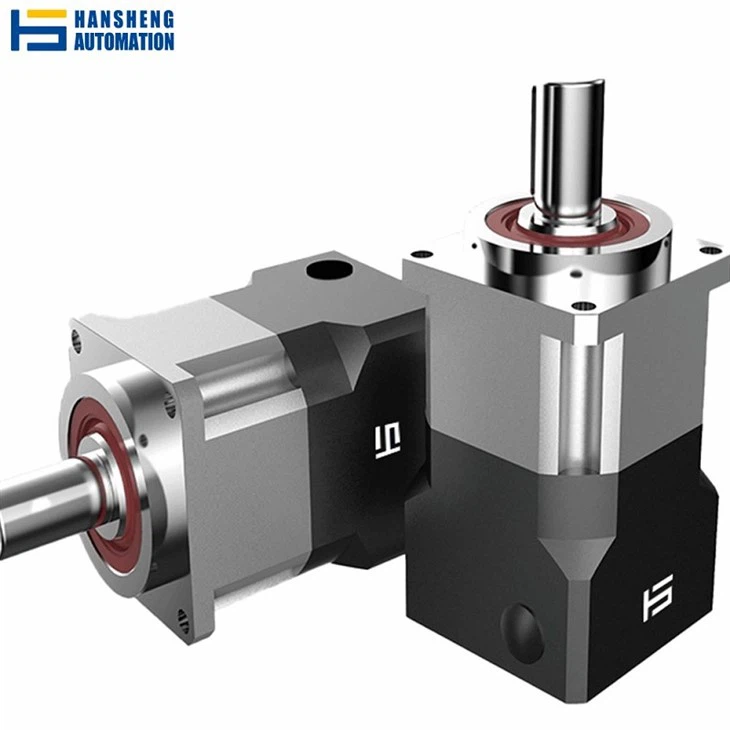
Right - angle planetary gearboxes, on the other hand, have input and output shafts that are perpendicular to each other. This is achieved through the use of bevel gears or worm gears in addition to the planetary gear set. The bevel gears or worm gears are used to change the direction of the power flow by 90 degrees. The planetary gear set still provides the speed reduction and torque multiplication functions, but the right - angle configuration allows for more flexibility in the layout of the machinery.
The right - angle design of these gearboxes is particularly useful in applications where space is limited or where the power needs to be transmitted in a non - linear direction. However, the addition of the bevel or worm gears can increase the complexity of the gearbox and may result in slightly lower efficiency compared to parallel - shaft planetary gearboxes.
2. Performance Differences
Efficiency
Parallel - shaft planetary gearboxes generally have higher efficiency compared to right - angle planetary gearboxes. The parallel arrangement of the shafts and the direct power transmission path result in less energy loss due to friction and gear meshing. In a well - designed parallel - shaft planetary gearbox, the efficiency can reach up to 95% or even higher, depending on the number of stages and the quality of the gears.
Right - angle planetary gearboxes, due to the additional bevel or worm gears, have more sources of friction and power loss. The efficiency of a right - angle planetary gearbox typically ranges from 80% to 90%, depending on the design and the operating conditions. However, advancements in gear manufacturing technology have been able to reduce these losses and improve the efficiency of right - angle gearboxes over the years.
Torque Capacity
Both parallel - shaft and right - angle planetary gearboxes can provide high torque capacity. The torque capacity of a planetary gearbox is determined by the size of the gears, the number of teeth, and the material used. In general, parallel - shaft planetary gearboxes can handle higher torque loads due to their more straightforward power transmission path and the ability to evenly distribute the load across multiple gears.
Right - angle planetary gearboxes, while also capable of providing significant torque, may have some limitations due to the additional stresses imposed on the bevel or worm gears. However, modern right - angle planetary gearboxes are designed to withstand high torque loads, and with proper selection and sizing, they can be used in applications that require high torque output.
Speed Range
Parallel - shaft planetary gearboxes are suitable for a wide range of speed applications. They can be designed to provide high - speed reduction ratios for applications that require low output speeds, such as in conveyor systems or industrial mixers. At the same time, they can also be used in applications that require high - speed operation, as long as the gears are properly lubricated and balanced.

Right - angle planetary gearboxes are often used in applications where moderate to low speeds are required. The bevel or worm gears used in these gearboxes are not as suitable for high - speed operation due to the increased friction and wear. However, they can provide smooth and precise speed control, which is important in applications such as robotics and automation.
3. Application Differences
Parallel - Shaft Planetary Gearboxes
Parallel - shaft planetary gearboxes are commonly used in applications where high efficiency, high torque, and a wide speed range are required. Some of the typical applications include:
- Conveyor Systems: In conveyor systems, parallel - shaft planetary gearboxes are used to drive the conveyor belts. The high torque capacity and efficiency of these gearboxes ensure smooth and reliable operation of the conveyor, even when carrying heavy loads.
- Industrial Mixers: Industrial mixers require a gearbox that can provide high torque at low speeds to mix the materials effectively. Parallel - shaft planetary gearboxes are ideal for this application due to their ability to handle high torque loads and provide precise speed control.
- Machine Tools: Machine tools such as lathes, milling machines, and grinders require a gearbox that can provide high - speed reduction and accurate positioning. Parallel - shaft planetary gearboxes can meet these requirements and are widely used in the machine tool industry.
You can explore our High Precision Planetary Gearboxes for more options suitable for these applications.
Right - Angle Planetary Gearboxes
Right - angle planetary gearboxes are preferred in applications where space is limited or where the power needs to be transmitted at a 90 - degree angle. Some of the common applications include:
- Robotics: In robotics, right - angle planetary gearboxes are used to drive the joints of the robot. The compact size and right - angle configuration of these gearboxes allow for a more flexible design of the robot arm, while the high torque capacity and precise speed control ensure accurate movement of the robot.
- Automation Systems: Automation systems often require gearboxes that can be integrated into a tight space and provide a 90 - degree power transmission. Right - angle planetary gearboxes are well - suited for this application and are commonly used in automated assembly lines, packaging machines, and material handling systems.
- Printing Presses: Printing presses require a gearbox that can provide high torque at low speeds and change the direction of the power flow. Right - angle planetary gearboxes are used in printing presses to drive the rollers and other moving parts, ensuring smooth and precise operation of the printing process.
For more information on our Planetary Gear Systems and how they can be applied in these areas, please visit our website.
4. Cost Considerations
The cost of a planetary gearbox depends on several factors, including the type, size, torque capacity, and precision requirements. In general, parallel - shaft planetary gearboxes are relatively less expensive compared to right - angle planetary gearboxes. The simpler structure and fewer components of parallel - shaft gearboxes result in lower manufacturing costs.
Right - angle planetary gearboxes, due to their more complex design and the use of additional bevel or worm gears, are more expensive to manufacture. However, the cost difference may be justified in applications where the right - angle configuration is essential for the proper functioning of the machinery.
5. Making the Right Choice
When choosing between a parallel - shaft and a right - angle planetary gearbox, you need to consider several factors, including the application requirements, space limitations, efficiency, torque capacity, and cost. If your application requires high efficiency, high torque, and a wide speed range, and there are no space or layout restrictions, a parallel - shaft planetary gearbox may be the best choice.
On the other hand, if your application has limited space or requires the power to be transmitted at a 90 - degree angle, a right - angle planetary gearbox may be more suitable. It is also important to consider the long - term operating costs, including maintenance and energy consumption, when making your decision.
As a leading supplier of Planetary Gearboxes, we have a wide range of parallel - shaft and right - angle planetary gearboxes to meet your specific needs. Our team of experts can help you select the most suitable gearbox for your application and provide you with professional advice and support. If you are interested in our products or have any questions, please feel free to contact us for further discussion and procurement negotiation. We look forward to working with you to find the perfect gearbox solution for your project.
References
- "Planetary Gearbox Handbook" by Gear Technology Publishing
- "Mechanical Design and Manufacturing" by John Doe
- Industry reports on planetary gearbox applications and technologies